European Economic
and Social Committee
European Economic
and Social Committee
The European Economic and Social Committee (EESC) is the voice of organised civil society in Europe.
Find out more about its role and structure at http://www.eesc.europa.eu/en/about
The EESC issues between 160 and 190 opinions, evaluation and information reports a year.
It also organises several annual initiatives and events with a focus on civil society and citizens’ participation such as the Civil Society Prize, the Civil Society Days, the Your Europe, Your Say youth plenary and the ECI Day.
Find the latest EESC opinions and publications at http://www.eesc.europa.eu/en/our-work/opinions-information-reports/opinions and http://www.eesc.europa.eu/en/our-work/publications-other-work/publications respectively.
The EESC is active in a wide range of areas, from social affairs to economy, energy and sustainability.
Learn more about our policy areas and policy highlights at http://www.eesc.europa.eu/en/policies
The EESC holds nine plenary sessions per year. It also organises many conferences, public hearings and high-level debates related to its work.
Find out more about our upcoming events at http://www.eesc.europa.eu/en/agenda/our-events/upcoming-events
Here you can find news and information about the EESC'swork, including its social media accounts, the EESC Info newsletter, photo galleries and videos.
Read the latest EESC news http://www.eesc.europa.eu/en/news-media/news and press releases http://www.eesc.europa.eu/en/news-media/press-releases
The EESC brings together representatives from all areas of organised civil society, who give their independent advice on EU policies and legislation. The EESC's326 Members are organised into three groups: Employers, Workers and Various Interests.
Find out more about our Members and groups at http://www.eesc.europa.eu/en/members-groups
The EESC has six sections, specialising in concrete topics of relevance to the citizens of the European Union, ranging from social to economic affairs, energy, environment, external relations or the internal market.
Find out more at http://www.eesc.europa.eu/en/sections-other-bodies
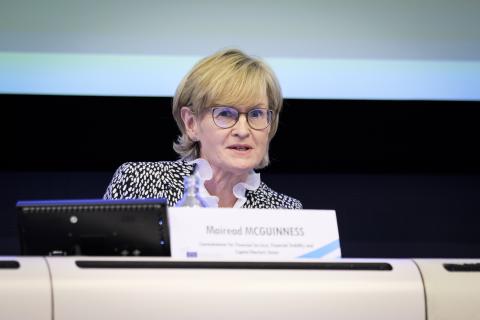
Nell'ultima sessione plenaria il Comitato economico e sociale europeo ha tenuto un dibattito con il commissario europeo McGuinness su come realizzare un sistema economico e finanziario europeo più verde, più sostenibile e più digitalizzato.
Nel corso della plenaria il Comitato ha adottato diversi pareri con l'obiettivo di contribuire a spianare la strada ad un'UE che sia veramente più sostenibile. In un parere d'iniziativa il CESE propone di elaborare una serie di nuovi indicatori per integrare il PIL e contribuire alla transizione. In un altro parere il CESE sostiene l'obiettivo di riorientare gli investimenti, ma osserva che molte delle misure proposte dalla Commissione nella sua strategia rinnovata in materia di finanza sostenibile appaiono spesso troppo esitanti e non considerano il concetto fondamentale di sostenibilità sociale. Inoltre, la tassonomia dell'UE non tiene conto nella stessa misura degli obiettivi ambientali e sociali e lascia dei dubbi su alcune attività economiche controverse. Infine, in un terzo parere, il CESE approva l'idea di una nuova norma volontaria per le obbligazioni verdi europee e formula delle raccomandazioni critiche su come trasformarla in uno strumento veramente efficace per contribuire ad orientare gli investitori verso progetti con un impatto positivo sull'ambiente. (tk)