Europe is facing a pivotal moment. Social and economic inequalities, rapid technological change, anti-democratic forces and geopolitical instability are straining the foundations of the European project.
With democracy and civic space under mounting pressure, civil society organisations, human rights defenders and free media face growing constraints - from restrictive laws and disinformation campaigns to underfunding and public distrust. Deepening polarisation and eroding trust in institutions further undermine Europe’s democratic model.
This study examines how social partners and civil society organisations in six Member States — Italy, Austria, Hungary, Poland, Portugal and Sweden — view the effectiveness of current policies in raising employment levels and increasing adult participation in training. It also puts forward recommendations for improving policy outcomes.
This resolution presents recommendations of the European Economic and Social Committee to the legislature 2024-2029. They are based on discussions with social partners and civil society organizations from all walks of life, including young people during the first EESC Civil Society Week, and contain a comprehensive set of actionable steps to strengthen and safeguard democratic principles.
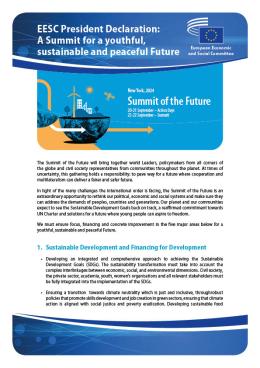
Between 20-23 September, EESC President Oliver Röpke led a delegation of the European Economic and Social Committee to the United Nations Summit of the Future, which took place in New York. The event, a cornerstone in discussions about the future of multilateral cooperation, focused on urgent global challenges including sustainable development, peace, security, and digital governance.
This study explores effective practices for youth participation in policy and decision-making processes, providing a comprehensive overview of what youth participation means and its key characteristics
The EESC is now applying the EU Youth Test to its opinions, a tool designed to strengthen youth participation and youth mainstreaming in policy-making, becoming the first EU institution to implement it
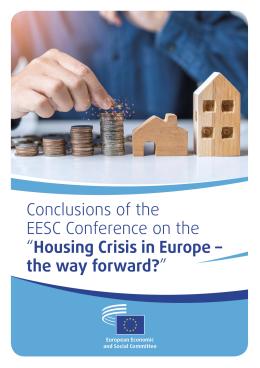
On 20 February 2024 in Brussels, the EESC organised a conference on the Housing Crisis in Europe. This publication sets out the participants' assessment of the current state of affairs and their recommendations on how to tackle the current housing crisis.