European Economic
and Social Committee
European Economic
and Social Committee
The European Economic and Social Committee (EESC) is the voice of organised civil society in Europe.
Find out more about its role and structure at http://www.eesc.europa.eu/en/about
The EESC issues between 160 and 190 opinions, evaluation and information reports a year.
It also organises several annual initiatives and events with a focus on civil society and citizens’ participation such as the Civil Society Prize, the Civil Society Days, the Your Europe, Your Say youth plenary and the ECI Day.
Find the latest EESC opinions and publications at http://www.eesc.europa.eu/en/our-work/opinions-information-reports/opinions and http://www.eesc.europa.eu/en/our-work/publications-other-work/publications respectively.
The EESC is active in a wide range of areas, from social affairs to economy, energy and sustainability.
Learn more about our policy areas and policy highlights at http://www.eesc.europa.eu/en/policies
The EESC holds nine plenary sessions per year. It also organises many conferences, public hearings and high-level debates related to its work.
Find out more about our upcoming events at http://www.eesc.europa.eu/en/agenda/our-events/upcoming-events
Here you can find news and information about the EESC'swork, including its social media accounts, the EESC Info newsletter, photo galleries and videos.
Read the latest EESC news http://www.eesc.europa.eu/en/news-media/news and press releases http://www.eesc.europa.eu/en/news-media/press-releases
The EESC brings together representatives from all areas of organised civil society, who give their independent advice on EU policies and legislation. The EESC's326 Members are organised into three groups: Employers, Workers and Various Interests.
Find out more about our Members and groups at http://www.eesc.europa.eu/en/members-groups
The EESC has six sections, specialising in concrete topics of relevance to the citizens of the European Union, ranging from social to economic affairs, energy, environment, external relations or the internal market.
Find out more at http://www.eesc.europa.eu/en/sections-other-bodies
Under en debatt vid EESK den 24 januari framkom det att EU inte uppfyller målen i FN:s Agenda 2030. Men ännu är hoppet inte ute. EU har möjlighet att ta täten, bland annat genom ekonomiskt stöd. EESK spelar en viktig roll i övervakningsprocessen.
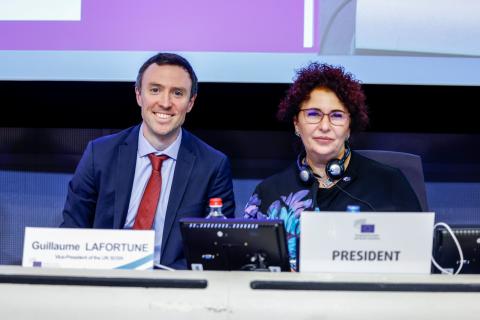
Vid EESK:s plenarsession i januari hölls en debatt om genomförandet av FN:s hållbarhetsmål, där Guillaume Lafortune, vice ordförande för FN:s nätverk för lösningar för hållbar utveckling, deltog.
Guillaume Lafortune redogjorde för innehållet i rapporten om hållbar utveckling i Europa 2022, som tagits fram med stöd av EESK. Enligt honom har EU misslyckats med att uppnå målen. Över hela världen har det skett en tillbakagång och framför allt utvecklingsländerna, som kämpar med allvarliga ekonomiska begränsningar, släpar efter.
En rekommendation i rapporten är att EU ska verka för en global plan inom FN för att öka det internationella ekonomiska stödet för hållbarhetsmålen. Denna idé fann gehör hos EESK:s ordförande Christa Schweng, som underströk hur betydelsefullt EU:s ledarskap är för att åstadkomma globala förändringar.
EESK kommer även att spela en central roll i Europeiska kommissionens första frivilliga översyn i juli 2023, som ska samla de berörda parternas synpunkter på framstegen mot hållbarhetsmålen. EESK rekommenderade en övergripande strategi för målen, med tanke på den inbördes kopplingen mellan målen och deras respektive delmål, och föreslog att en ny plattform ska lanseras för att främja ett strukturerat engagemang från det civila samhällets sida när det gäller politik som rör målen för hållbar utveckling. (gb)