European Economic
and Social Committee
European Economic
and Social Committee
The European Economic and Social Committee (EESC) is the voice of organised civil society in Europe.
Find out more about its role and structure at http://www.eesc.europa.eu/en/about
The EESC issues between 160 and 190 opinions, evaluation and information reports a year.
It also organises several annual initiatives and events with a focus on civil society and citizens’ participation such as the Civil Society Prize, the Civil Society Days, the Your Europe, Your Say youth plenary and the ECI Day.
Find the latest EESC opinions and publications at http://www.eesc.europa.eu/en/our-work/opinions-information-reports/opinions and http://www.eesc.europa.eu/en/our-work/publications-other-work/publications respectively.
The EESC is active in a wide range of areas, from social affairs to economy, energy and sustainability.
Learn more about our policy areas and policy highlights at http://www.eesc.europa.eu/en/policies
The EESC holds nine plenary sessions per year. It also organises many conferences, public hearings and high-level debates related to its work.
Find out more about our upcoming events at http://www.eesc.europa.eu/en/agenda/our-events/upcoming-events
Here you can find news and information about the EESC'swork, including its social media accounts, the EESC Info newsletter, photo galleries and videos.
Read the latest EESC news http://www.eesc.europa.eu/en/news-media/news and press releases http://www.eesc.europa.eu/en/news-media/press-releases
The EESC brings together representatives from all areas of organised civil society, who give their independent advice on EU policies and legislation. The EESC's326 Members are organised into three groups: Employers, Workers and Various Interests.
Find out more about our Members and groups at http://www.eesc.europa.eu/en/members-groups
The EESC has six sections, specialising in concrete topics of relevance to the citizens of the European Union, ranging from social to economic affairs, energy, environment, external relations or the internal market.
Find out more at http://www.eesc.europa.eu/en/sections-other-bodies
Дебат, проведен в ЕИСК на 24 януари, показа, че ЕС не успява да постигне целите на Програмата на ООН за 2030 г. Въпреки това има надежда. ЕС има възможност да поеме водеща роля, включително чрез финансова подкрепа. ЕИСК играе важна роля в мониторинга на напредъка.
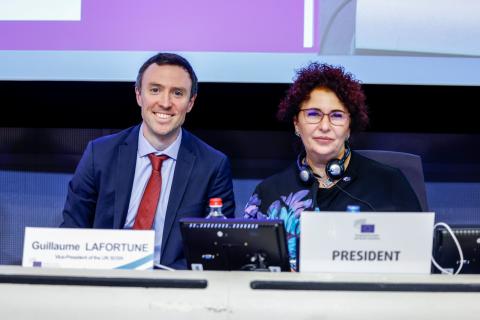
На януарската си пленарна сесия ЕИСК беше домакин на дебат с участието на Гийом Лафортюн, заместник-председател на Мрежата на ООН за решения за устойчиво развитие (UN SDSN), относно изпълнението на целите на ООН за устойчиво развитие (ЦУР).
Г-н Лафортюн представи доклада за устойчивото развитие на Европа за 2022 г., изготвен с подкрепата на ЕИСК. Според г-н Лафортюн ЕС не успява да постигне целите. Междувременно в световен план напредък не се наблюдава, и по-специално изостават развиващите се страни, които са изправени пред сериозни финансови ограничения.
В доклада се препоръчва в рамките на системата на ООН ЕС да се застъпи за глобален план за увеличаване на международното финансиране за ЦУР. Председателката на ЕИСК Криста Швенг подкрепи тази идея, като подчерта значението на водещата роля на ЕС за постигането на глобални трансформации.
ЕИСК ще играе ключова роля и в провеждането на първия доброволен преглед от Европейската комисия през юли 2023 г., при който ще бъдат събрани мненията на заинтересованите страни относно напредъка към постигането на ЦУР. ЕИСК препоръча хоризонтален подход към целите, като се има предвид взаимосвързаният характер на ЦУР и съответните им конкретни цели, и предложи създаването на нова платформа за насърчаване на структурираното участие на гражданското общество в политиката, свързана с ЦУР. (gb)