European Economic
and Social Committee
European Economic
and Social Committee
The European Economic and Social Committee (EESC) is the voice of organised civil society in Europe.
Find out more about its role and structure at http://www.eesc.europa.eu/en/about
The EESC issues between 160 and 190 opinions, evaluation and information reports a year.
It also organises several annual initiatives and events with a focus on civil society and citizens’ participation such as the Civil Society Prize, the Civil Society Days, the Your Europe, Your Say youth plenary and the ECI Day.
Find the latest EESC opinions and publications at http://www.eesc.europa.eu/en/our-work/opinions-information-reports/opinions and http://www.eesc.europa.eu/en/our-work/publications-other-work/publications respectively.
The EESC is active in a wide range of areas, from social affairs to economy, energy and sustainability.
Learn more about our policy areas and policy highlights at http://www.eesc.europa.eu/en/policies
The EESC holds nine plenary sessions per year. It also organises many conferences, public hearings and high-level debates related to its work.
Find out more about our upcoming events at http://www.eesc.europa.eu/en/agenda/our-events/upcoming-events
Here you can find news and information about the EESC'swork, including its social media accounts, the EESC Info newsletter, photo galleries and videos.
Read the latest EESC news http://www.eesc.europa.eu/en/news-media/news and press releases http://www.eesc.europa.eu/en/news-media/press-releases
The EESC brings together representatives from all areas of organised civil society, who give their independent advice on EU policies and legislation. The EESC's326 Members are organised into three groups: Employers, Workers and Various Interests.
Find out more about our Members and groups at http://www.eesc.europa.eu/en/members-groups
The EESC has six sections, specialising in concrete topics of relevance to the citizens of the European Union, ranging from social to economic affairs, energy, environment, external relations or the internal market.
Find out more at http://www.eesc.europa.eu/en/sections-other-bodies
Dibattitu li sar fil-KESE fl-24 ta’ Jannar wera li l-UE qed tonqos milli tilħaq l-objettivi tal-Aġenda 2030 tan-NU. Madankollu, għad hemm tama. L-UE għandha l-opportunità li tieħu rwol ta’ tmexxija, inkluż permezz ta’ appoġġ finanzjarju. Il-KESE għandu rwol importanti fil-monitoraġġ tal-progress.
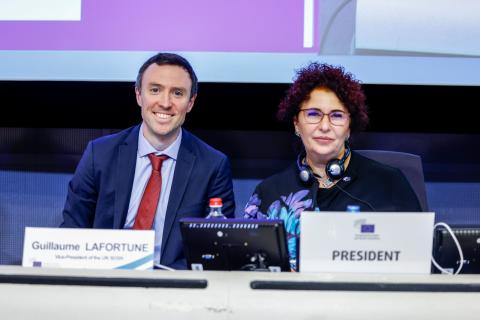
Waqt il-plenarja ta’ Jannar, il-KESE ospita dibattitu ma’ Guillaume Lafortune, Viċi President tan-Network ta’ Soluzzjonijiet ta’ Żvilupp Sostenibbli tan-NU (UN SDSN), dwar l-implimentazzjoni tal-Għanijiet ta’ Żvilupp Sostenibbli (SDGs).
Is-Sur Lafortune ppreżenta r-Rapport dwar l-Iżvilupp Sostenibbli tal-Ewropa 2022, li tfassal bl-appoġġ tal-KESE. Skont is-Sur Lafortune, l-UE mhux qed tilħaq l-objettivi. Fl-istess ħin, il-progress qed imur lura madwar id-dinja, u b’mod partikolari, il-pajjiżi li qed jiżviluppaw li jaffaċċjaw restrizzjonijiet ta’ finanzjament, għadhom lura.
Ir-rapport jirrakkomanda li l-UE tappoġġja, fl-ambitu tan-Nazzjonijiet Uniti, sistema għal pjan globali sabiex jiżdied il-finanzjament internazzjonali għall-SDGs. Il-President tal-KESE Christa Schweng tenniet din l-idea billi enfasizzat fuq l-importanza li l-UE jkollha rwol ta’ tmexxija fil-kisba tat-trasformazzjonijiet globali.
Il-KESE se jkollu wkoll rwol fundamentali fl-Ewwel Rieżami Volontarju tal-Kummissjoni Ewropea li huwa previst f’Lulju 2023, billi se jiġbor il-fehmiet tal-partijiet ikkonċernati fir-rigward tal-progress fil-qasam tal-SDGs. Il-KESE rrakkomanda approċċ trasversali fir-rigward tal-għanijiet, billi titqies in-natura interrelatata tal-SDGs u l-miri rispettivi tagħhom, u ppropona t-tnedija ta’ pjattaforma ġdida biex jitrawwem l-involviment strutturat tas-soċjetà ċivili dwar il-politika relatata mal-SDGs. (gb)