European Economic
and Social Committee
European Economic
and Social Committee
The European Economic and Social Committee (EESC) is the voice of organised civil society in Europe.
Find out more about its role and structure at http://www.eesc.europa.eu/en/about
The EESC issues between 160 and 190 opinions, evaluation and information reports a year.
It also organises several annual initiatives and events with a focus on civil society and citizens’ participation such as the Civil Society Prize, the Civil Society Days, the Your Europe, Your Say youth plenary and the ECI Day.
Find the latest EESC opinions and publications at http://www.eesc.europa.eu/en/our-work/opinions-information-reports/opinions and http://www.eesc.europa.eu/en/our-work/publications-other-work/publications respectively.
The EESC is active in a wide range of areas, from social affairs to economy, energy and sustainability.
Learn more about our policy areas and policy highlights at http://www.eesc.europa.eu/en/policies
The EESC holds nine plenary sessions per year. It also organises many conferences, public hearings and high-level debates related to its work.
Find out more about our upcoming events at http://www.eesc.europa.eu/en/agenda/our-events/upcoming-events
Here you can find news and information about the EESC'swork, including its social media accounts, the EESC Info newsletter, photo galleries and videos.
Read the latest EESC news http://www.eesc.europa.eu/en/news-media/news and press releases http://www.eesc.europa.eu/en/news-media/press-releases
The EESC brings together representatives from all areas of organised civil society, who give their independent advice on EU policies and legislation. The EESC's326 Members are organised into three groups: Employers, Workers and Various Interests.
Find out more about our Members and groups at http://www.eesc.europa.eu/en/members-groups
The EESC has six sections, specialising in concrete topics of relevance to the citizens of the European Union, ranging from social to economic affairs, energy, environment, external relations or the internal market.
Find out more at http://www.eesc.europa.eu/en/sections-other-bodies
Op 24 januari bleek tijdens een debat in het EESC dat de EU de doelstellingen van de VN-agenda 2030 niet lijkt te gaan halen. Maar er is hoop. De EU heeft de kans om het voortouw te gaan nemen, onder meer door middel van financiële steun. Wat het toezicht betreft is hierbij voor het EESC een belangrijke rol weggelegd.
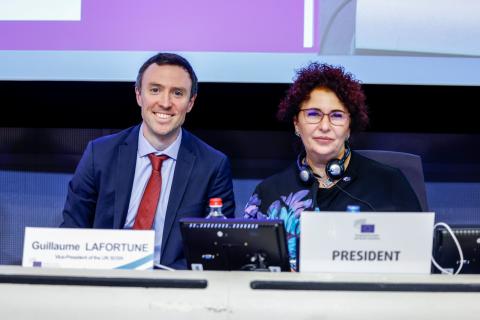
Tijdens de januari-zitting van het EESC werd een debat gehouden met Guillaume Lafortune, vicevoorzitter van het Sustainable Development Solutions Network van de VN (UN SDSN), over de verwezenlijking van de VN-doelen voor duurzame ontwikkeling (SDG's).
De heer Lafortune presenteerde het met steun van het EESC geschreven Europe Sustainable Development Report 2022. Volgens de heer Lafortune lukt het de EU momenteel niet om de doelstellingen te halen. Tegelijkertijd wordt er in de hele wereld steeds minder voortgang geboekt en hebben vooral de ontwikkelingslanden, die met ernstige financieringsproblemen kampen, een achterstand opgelopen.
Volgens het rapport zou de EU zich binnen het VN-systeem sterk moeten maken voor een mondiaal plan om de internationale financiering voor de SDG's op te voeren. EESC-voorzitter Christa Schweng onderschreef dit en wees erop hoe belangrijk het leiderschap van de EU is voor de verwezenlijking van wereldwijde veranderingen.
Door standpunten van belanghebbenden over de vorderingen met de SDG’s te verzamelen zal het EESC ook een belangrijke rol spelen bij de voor juli 2023 verwachte eerste vrijwillige evaluatie van de verwezenlijking van deze doelstellingen. Het EESC pleitte voor een horizontale benadering van de doelstellingen, gezien de onderlinge samenhang van de SDG’s en hun respectieve streefdoelen, en stelde voor om met de oprichting van een nieuw platform te zorgen voor een grotere structurele inbreng van het maatschappelijk middenveld in SDG-beleid. (gb)