European Economic
and Social Committee
European Economic
and Social Committee
The European Economic and Social Committee (EESC) is the voice of organised civil society in Europe.
Find out more about its role and structure at http://www.eesc.europa.eu/en/about
The EESC issues between 160 and 190 opinions, evaluation and information reports a year.
It also organises several annual initiatives and events with a focus on civil society and citizens’ participation such as the Civil Society Prize, the Civil Society Days, the Your Europe, Your Say youth plenary and the ECI Day.
Find the latest EESC opinions and publications at http://www.eesc.europa.eu/en/our-work/opinions-information-reports/opinions and http://www.eesc.europa.eu/en/our-work/publications-other-work/publications respectively.
The EESC is active in a wide range of areas, from social affairs to economy, energy and sustainability.
Learn more about our policy areas and policy highlights at http://www.eesc.europa.eu/en/policies
The EESC holds nine plenary sessions per year. It also organises many conferences, public hearings and high-level debates related to its work.
Find out more about our upcoming events at http://www.eesc.europa.eu/en/agenda/our-events/upcoming-events
Here you can find news and information about the EESC'swork, including its social media accounts, the EESC Info newsletter, photo galleries and videos.
Read the latest EESC news http://www.eesc.europa.eu/en/news-media/news and press releases http://www.eesc.europa.eu/en/news-media/press-releases
The EESC brings together representatives from all areas of organised civil society, who give their independent advice on EU policies and legislation. The EESC's326 Members are organised into three groups: Employers, Workers and Various Interests.
Find out more about our Members and groups at http://www.eesc.europa.eu/en/members-groups
The EESC has six sections, specialising in concrete topics of relevance to the citizens of the European Union, ranging from social to economic affairs, energy, environment, external relations or the internal market.
Find out more at http://www.eesc.europa.eu/en/sections-other-bodies
A debate held at the EESC on 24 January revealed that the EU is failing to meet the objectives of the UN's 2030 Agenda. Yet there is hope. The EU has the opportunity to take the lead, including through financial support. The EESC plays an important role in monitoring progress.
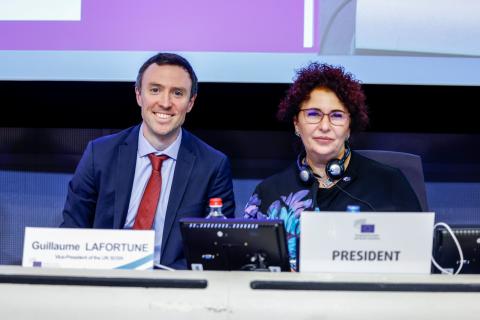
The EESC January plenary hosted a debate with Guillaume Lafortune, Vice-President of the UN Sustainable Development Solutions Network (UN SDSN), on the implementation of the UN Sustainable Development Goals (SDGs).
Mr Lafortune presented the 2022 Europe Sustainable Development Report, written with the support of the EESC. According to Mr Lafortune, the EU is failing to meet the objectives. In the meantime, progress is deteriorating across the world, and developing countries in particular, which face severe financing constraints, are lagging behind.
The report recommends that the EU advocate within the United Nations system for a global plan to scale up international finance for the SDGs. EESC President Christa Schweng echoed this idea by highlighting the importance of the EU's leadership in achieving global transformations.
The EESC will also play a key role in the European Commission's First Voluntary Review in July 2023, gathering stakeholders' views on progress towards the SDGs. The EESC recommended a cross-cutting approach to the goals, considering the interrelated nature of the SDGs and their respective targets, and proposed launching a new platform to foster structured civil society engagement on SDG-related policy. (gb)