European Economic
and Social Committee
European Economic
and Social Committee
The European Economic and Social Committee (EESC) is the voice of organised civil society in Europe.
Find out more about its role and structure at http://www.eesc.europa.eu/en/about
The EESC issues between 160 and 190 opinions, evaluation and information reports a year.
It also organises several annual initiatives and events with a focus on civil society and citizens’ participation such as the Civil Society Prize, the Civil Society Days, the Your Europe, Your Say youth plenary and the ECI Day.
Find the latest EESC opinions and publications at http://www.eesc.europa.eu/en/our-work/opinions-information-reports/opinions and http://www.eesc.europa.eu/en/our-work/publications-other-work/publications respectively.
The EESC is active in a wide range of areas, from social affairs to economy, energy and sustainability.
Learn more about our policy areas and policy highlights at http://www.eesc.europa.eu/en/policies
The EESC holds nine plenary sessions per year. It also organises many conferences, public hearings and high-level debates related to its work.
Find out more about our upcoming events at http://www.eesc.europa.eu/en/agenda/our-events/upcoming-events
Here you can find news and information about the EESC'swork, including its social media accounts, the EESC Info newsletter, photo galleries and videos.
Read the latest EESC news http://www.eesc.europa.eu/en/news-media/news and press releases http://www.eesc.europa.eu/en/news-media/press-releases
The EESC brings together representatives from all areas of organised civil society, who give their independent advice on EU policies and legislation. The EESC's326 Members are organised into three groups: Employers, Workers and Various Interests.
Find out more about our Members and groups at http://www.eesc.europa.eu/en/members-groups
The EESC has six sections, specialising in concrete topics of relevance to the citizens of the European Union, ranging from social to economic affairs, energy, environment, external relations or the internal market.
Find out more at http://www.eesc.europa.eu/en/sections-other-bodies
Podczas debaty, która odbyła się w EKES-ie 24 stycznia, stwierdzono, że UE nie udaje się spełnić celów Agendy 2030 ONZ. Jednak wciąż jest nadzieja. UE może wysunąć się na czoło, między innymi udzielając wsparcia finansowego. EKES odgrywa istotną rolę w monitorowaniu postępów.
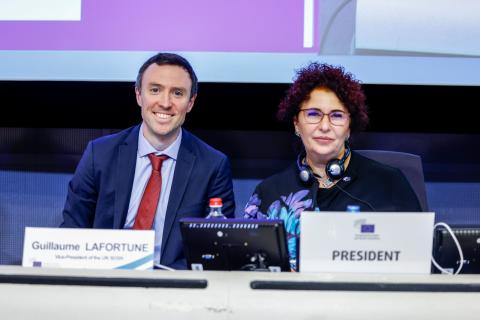
Na styczniowej sesji plenarnej EKES-u odbyła się debata w sprawie realizacji celów zrównoważonego rozwoju ONZ z udziałem Guillaume’a Lafortune’a, wiceprzewodniczącego Sieci Rozwiązań na Rzecz Zrównoważonego Rozwoju ONZ (SDSN ONZ).
Guillaume Lafortune przedstawił sporządzone z pomocą EKES-u sprawozdanie na temat zrównoważonego rozwoju Europy z 2022 r. Jego zdaniem UE nie udaje się spełnić wytyczonych celów. Postępy spowalniają również na całym świecie, szczególnie w krajach rozwijających się, które borykają się z poważnymi ograniczeniami w zakresie finansowania i pozostają w tyle za innymi.
W sprawozdaniu zalecono, by w systemie Narodów Zjednoczonych UE opowiedziała się za globalnym planem zwiększenia środków międzynarodowych na realizację celów zrównoważonego rozwoju. Przewodnicząca EKES-u Christa Schweng nawiązała do tej idei, podkreślając wagę przywództwa UE w dążeniu do globalnej transformacji.
EKES będzie również odgrywać istotną rolę w pierwszym dobrowolnym przeglądzie Komisji Europejskiej w lipcu 2023 r., sondując opinie zainteresowanych stron w sprawie postępów w realizacji celów zrównoważonego rozwoju. Zalecił również przyjęcie przekrojowego podejścia, biorąc pod uwagę wzajemne powiązania między celami i wyznaczonymi w ich ramach zadaniami, oraz zaproponował uruchomienie nowej platformy zorganizowanego udziału społeczeństwa obywatelskiego w polityce z nimi związanej. (gb)