
European Economic
and Social Committee
Co-creation of public services in the health sector will contribute to a more participative democracy in the EU
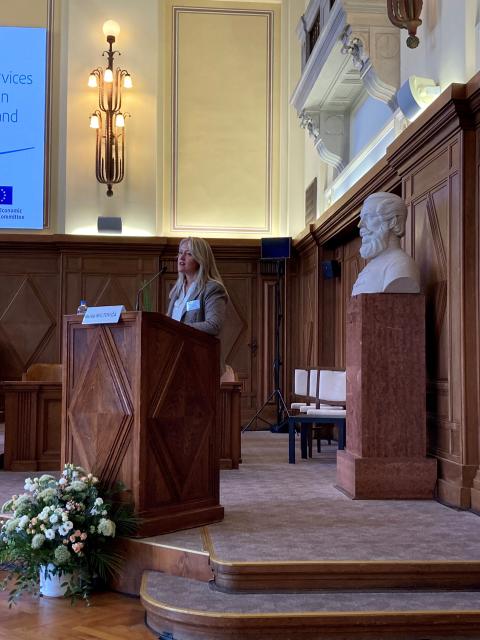
This event organised by the European Economic and Social Committee (EESC) and the University of Debrecen highlighted the crucial importance of co-creating services of general interest in the area of health and well-being, especially in light of the lessons learned from the COVID-19 pandemic.
Health and well-being are two areas where public and private organisations can work together with citizens to provide services of general interest. However, in the post-COVID society, they need to be backed by new European initiatives and policies.
This is the key takeaway of the high-level conference on Co-creation and services of general interest in the field of health and well-being, jointly organised by the EESC's Section for Transport, Energy, Infrastructure and the Information Society (TEN) and the University of Debrecen, Hungary on 15-16 September 2022.
The EESC has long been involved in the discussion at European level on modernising and developing services of general interest in cooperation with various stakeholders from civil society and the world of academia and research
, said Baiba Miltoviča, president of the EESC's TEN section. Today's conference is a continuation of our efforts to ensure that all citizens and stakeholders have access to essential services that form and will continue to form the basis for a decent life
.
Services of general interest and civil society organisations
The event focused on the co-creation of services of general interest and on health and care services of general interest, highlighting the roles and opportunities for civil society organisations and academia.
On this topic, the EESC is currently drafting an opinion entitled the Co-creation of services of general interest as a contribution to a more participative democracy in the EU, which puts forward concrete actions to stimulate participative democracy and ensure that people's needs are met, including setting up a forum to exchange ideas and best practices, and advance the debate at European level.
András Edelényi, president of the EESC study group, said: nowadays more than ever, it is important to strengthen our societal resilience. We need contribution and coordination from and between the public, civil and individual spheres and their resources. Services of general interest are in the cross-section of that
.
Krzysztof Balon, president of the EESC Permanent Group on Services of General Interest, added: the co-creation of services of general interest by civil society organisations, answering the real needs of European citizens, is one of the most effective tools for stimulating participative democracy, and thus for bolstering European integration. For this reason, the EESC, in cooperation with civil society, universities and municipalities, as well as with the other EU institutions, intensively works on new political initiatives in this area at both European and national levels
.
Referring to the current difficult international situation, Gusztáv Báger, acting President of the Hungarian National Economic and Social Committee, stressed that the war in Ukraine posed a major challenge to all civil society organisations across Europe, and that this had shown the strength and importance of civil society in searching for common solutions and, in particular, for helping refugees.
The need for stronger cooperation in health and well-being in a post-COVID EU
The COVID-19 crisis has made clear that innovative approaches and solutions are urgently needed in health and in a wide range of health-related services that focus on health literacy, communication with citizens, well-being, health support services and different forms of care.
Piroska Ailer, Vice Rector at the University of Debrecen, underlined that the pandemic had drawn attention to the need for cooperation between an increasing number of fields and actors, and that the University of Debrecen, as one of the largest healthcare providers in Hungary, could thoroughly contribute to formulating proposals at European level, based on its considerable experience.
According to Flórián Sipos from the University of Debrecen, the co-creation of health services is timely and based on the concept of active citizens with valuable assets, such as experience, who can contribute to a better final result.
Background – co-creation of public services
The co-creation of public services is a form of social innovation and participatory democracy in Europe. It is based on the idea that public sector innovations can be best achieved by bringing about cooperation or partnership between public service providers (NGOs, public sector agencies, private companies) and the citizens who use or benefit from their services.
Within co-creation, people who use or potentially use services work with providers in various stages of the development process and initiate, design, deliver and evaluate the new services. In the 2010s, public services in the EU gradually shifted from working with citizens as passive individual consumers of services, to citizens as active and dynamic contributors.
Work organisation
Downloads
-
Co-creation of public services in the health sector will contribute to a more participative democracy in the EU
Recommended for you
Energi – EESK varnar för nya beroendeförhållanden
News
Europeiska ekonomiska och sociala kommittén (EESK) intar en fast hållning i energifrågan i ett yttrande som antogs vid dess plenarsession i september: kommissionens förslag är ett steg i rätt…
Svenska rådsordförandeskapet 2023: Ukraina står fortfarande högst upp på dagordningen
News
Vid Europeiska ekonomiska och sociala kommitténs (EESK) plenarsession i januari hölls en debatt under vilken Sveriges EU-minister Jessika Roswall redogjorde för prioriteringarna för det nya…
Ditt Europa, din mening! 2023: Ungdomar efterlyser ett mer transparent, digitalt och förenklat EU
News
Den 23–24 mars stod Europeiska ekonomiska och sociala kommittén (EESK) för 14:e gången värd för ”Ditt Europa, din mening!” (YEYS!) i Bryssel, med 105 elever från 35 skolor från alla 27 EU-länder och…
EESK diskuterar agendan för det svenska EU-ordförandeskapet 2023
News
Vid sammanträdet i Europeiska ekonomiska och sociala kommittén (EESK) i Stockholm redogjorde Sveriges statssekreterare med ansvar för EU-frågor, Christian Danielsson, för den politiska inriktningen…
EU–Ukraina: driftskompatibilitet och solidaritet – nyckelfaktorer för transportförbindelserna
News
Vid en debatt som Europeiska ekonomiska och sociala kommittén (EESK) höll i Bryssel framhöll deltagarna vikten av infrastruktur och harmoniserade standarder för att sammanlänka EU med dess…