European Economic
and Social Committee
European Economic
and Social Committee
The European Economic and Social Committee (EESC) is the voice of organised civil society in Europe.
Find out more about its role and structure at http://www.eesc.europa.eu/en/about
The EESC issues between 160 and 190 opinions, evaluation and information reports a year.
It also organises several annual initiatives and events with a focus on civil society and citizens’ participation such as the Civil Society Prize, the Civil Society Days, the Your Europe, Your Say youth plenary and the ECI Day.
Find the latest EESC opinions and publications at http://www.eesc.europa.eu/en/our-work/opinions-information-reports/opinions and http://www.eesc.europa.eu/en/our-work/publications-other-work/publications respectively.
The EESC is active in a wide range of areas, from social affairs to economy, energy and sustainability.
Learn more about our policy areas and policy highlights at http://www.eesc.europa.eu/en/policies
The EESC holds nine plenary sessions per year. It also organises many conferences, public hearings and high-level debates related to its work.
Find out more about our upcoming events at http://www.eesc.europa.eu/en/agenda/our-events/upcoming-events
Here you can find news and information about the EESC'swork, including its social media accounts, the EESC Info newsletter, photo galleries and videos.
Read the latest EESC news http://www.eesc.europa.eu/en/news-media/news and press releases http://www.eesc.europa.eu/en/news-media/press-releases
The EESC brings together representatives from all areas of organised civil society, who give their independent advice on EU policies and legislation. The EESC's326 Members are organised into three groups: Employers, Workers and Various Interests.
Find out more about our Members and groups at http://www.eesc.europa.eu/en/members-groups
The EESC has six sections, specialising in concrete topics of relevance to the citizens of the European Union, ranging from social to economic affairs, energy, environment, external relations or the internal market.
Find out more at http://www.eesc.europa.eu/en/sections-other-bodies
skupina Zamestnávatelia v EHSV
Vytvorenie európskeho jednotného trhu prinieslo harmonizáciu a vzájomné uznávanie noriem a vďaka tomu môžu dnes podniky predávať svoje výrobky viac ako 450 miliónom ľudí. Tento trh, kde sa realizuje 61 % obchodných transakcií podnikov v rámci EÚ, predstavuje základ hospodárskej prosperity Európy, z čoho majú prospech jej občania, spotrebitelia, pracovníci aj podniky. Európska komisia odhaduje, že vnútorný trh vytvára 25 % hrubého domáceho produktu EÚ.
Nové výzvy, ako je digitálna transformácia a prechod na udržateľnejšie hospodárstvo s nižšími emisiami CO2, ale aj meniace sa potreby spotrebiteľov, zamestnancov a podnikov a nová geopolitická situácia, si však vyžadujú nové úpravy.
Na to, aby sa mohol jednotný trh ďalej úspešne rozvíjať, je nevyhnutné zlepšiť viaceré aspekty vrátane európskej energetickej a priemyselnej politiky, energetickej únie či bankovej únie. Okrem toho treba vytvoriť priaznivejší rámec pre veľké aj malé podniky, získať väčšiu podporu verejnosti pre európsky projekt, zefektívniť verejné služby a zlepšiť infraštruktúru v oblasti IT, energetiky a dopravy.
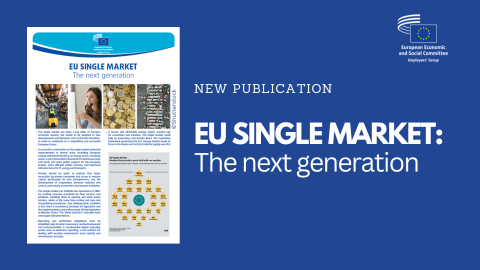
Keďže v prvom polroku 2024 majú byť uverejnené dve významné správy bývalých talianskych premiérov Enrica Lettu (o budúcnosti jednotného trhu) a Maria Draghiho (o budúcnosti európskej konkurencieschopnosti), skupina Zamestnávatelia v EHSV zhrnula svoje kľúčové posolstvá v záujme úspešnej budúcnosti vnútorného trhu EÚ v stručnom dokumente s názvom EU Single Market: the next generation (Jednotný trh EÚ: ďalšia generácia).
Novú publikáciu si môžete prečítať tu: europa.eu/!TVmdYg