European Economic
and Social Committee
European Economic
and Social Committee
The European Economic and Social Committee (EESC) is the voice of organised civil society in Europe.
Find out more about its role and structure at http://www.eesc.europa.eu/en/about
The EESC issues between 160 and 190 opinions, evaluation and information reports a year.
It also organises several annual initiatives and events with a focus on civil society and citizens’ participation such as the Civil Society Prize, the Civil Society Days, the Your Europe, Your Say youth plenary and the ECI Day.
Find the latest EESC opinions and publications at http://www.eesc.europa.eu/en/our-work/opinions-information-reports/opinions and http://www.eesc.europa.eu/en/our-work/publications-other-work/publications respectively.
The EESC is active in a wide range of areas, from social affairs to economy, energy and sustainability.
Learn more about our policy areas and policy highlights at http://www.eesc.europa.eu/en/policies
The EESC holds nine plenary sessions per year. It also organises many conferences, public hearings and high-level debates related to its work.
Find out more about our upcoming events at http://www.eesc.europa.eu/en/agenda/our-events/upcoming-events
Here you can find news and information about the EESC'swork, including its social media accounts, the EESC Info newsletter, photo galleries and videos.
Read the latest EESC news http://www.eesc.europa.eu/en/news-media/news and press releases http://www.eesc.europa.eu/en/news-media/press-releases
The EESC brings together representatives from all areas of organised civil society, who give their independent advice on EU policies and legislation. The EESC's326 Members are organised into three groups: Employers, Workers and Various Interests.
Find out more about our Members and groups at http://www.eesc.europa.eu/en/members-groups
The EESC has six sections, specialising in concrete topics of relevance to the citizens of the European Union, ranging from social to economic affairs, energy, environment, external relations or the internal market.
Find out more at http://www.eesc.europa.eu/en/sections-other-bodies
By the EESC Employers Group
Since the European single market was established, harmonisation and mutual recognition of standards have enabled companies to sell their products in a market of over 450 million people. It accounts for 61% of intra-EU trade by companies, and is the basis of Europe's economic prosperity, thus benefitting its citizens, consumers, workers and companies. The European Commission estimates that 25% of the EU's gross domestic product is generated by the internal market.
However, new developments, such as the digital transformation and the transition to a less carbon-intensive and more sustainable economy, require new adjustments, as do the changing needs of consumers, employees and companies and new geopolitical conditions.
The successful continuation of the single market requires improvements in several areas, including European energy and industrial policy, an energy union, a banking union, a more favourable framework for businesses large and small, and more public support for the European project, more efficient public services and improved infrastructure for IT, energy and transport.
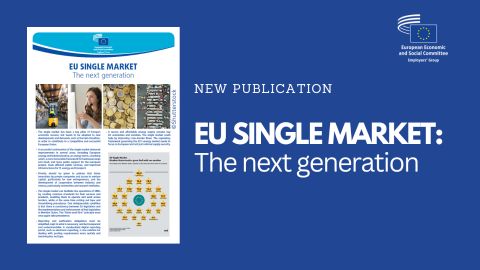
With two landmark reports by former Italian prime ministers, Enrico Letta ("Future of the Single Market") and Mario Draghi (on the future of European competitiveness) being published in the first half of 2024, the EESC's Employers Group has summarised its key messages for the successful future of the EU's internal market in its One Pager "EU Single Market: the next generation".
Read the new publication here: europa.eu/!TVmdYg