
European Economic
and Social Committee
The EU must completely reset its economic strategy to respond to new challenges
In an opinion adopted at the February plenary, the European Economic and Social Committee (EESC) warns the European Commission against the EU’s chronic lack of investment and highlights five political priorities for an ambitious European Semester based on investments, the single market and sustainable growth.
The 2026 European Semester is a turning point: if the EU wants to be able to respond to new global challenges, it needs to completely redefine its economic strategy and overturn its chronic lack of investment which undermines productivity, innovation and its strategic sovereignty.
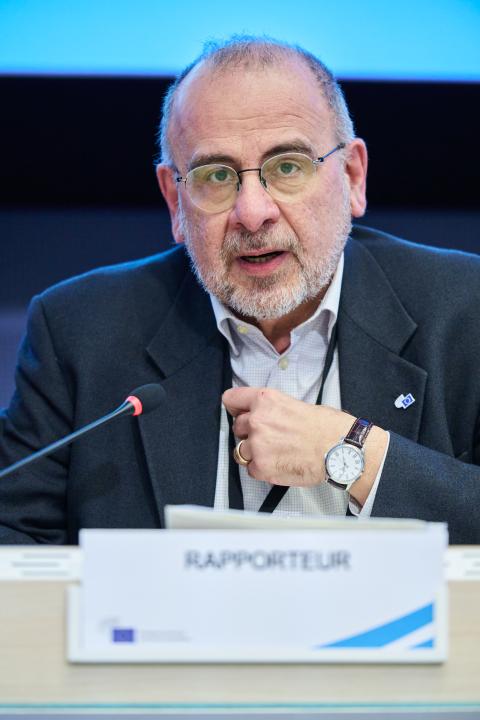
With its opinion 2026 European Semester – Autumn Package, drawn up by Luca Jahier and adopted at the February plenary session, the EESC takes a firm stand and is ready to fully support a European Semester which is worthy of common ambitions.
‘Europe cannot compete, innovate, or protect its citizens without more investment,’ said Mr Jahier, rapporteur for the EESC opinion. ‘Environmental, technological and demographic challenges are all interconnected and require a comprehensive and robust response. In addition, we need to put forward innovative ideas towards an integrated capital market and to strengthen the EU’s economic and social governance with indicators that include well-being beyond GDP’.
An ambitious European Semester
In the EESC’s view, the EU must offer a united response to the multiple challenges that it is currently facing: for example, geopolitical instability, the climate crisis, the technological and digital gap, and the demographic challenge.
More specifically, the Union must be ambitious and focus on competitiveness, resilience, social and territorial cohesion, all feeding into each other and working towards a European sovereign sustainability.
To this end, in order to improve the 2026 European Semester Autumn Package, the Committee puts forward a set of 18 solid recommendations which can be summed up in five key political priorities.
Large-scale investments
Firstly, the EESC strongly reiterates the need for a common fiscal capacity, supported by targeted issuance of European debt, and permanent macroeconomic stabilisation instruments, modelled on the success of the European instrument for temporary support to mitigate unemployment risks in an emergency (SURE). Without a qualitative leap in investments in infrastructure, technologies, welfare (including housing policies) and human capital, Europe will not be able to compete.
Integrated capital markets
Secondly, financial fragmentation is a political and economic obstacle. The Committee proposes a radical solution: it calls on the Commission to assess whether a regulatory framework like the 1996 US National Securities Markets Improvement Act (NSMIA) could be a model for simplifying cross-border access, reducing regulatory fragmentation, and finally creating a true single European market for capital, over 27 siloed systems. Only in this way can European savings finance European investments.
Strengthened economic and social governance
Third, the EU’s response must combine competitiveness and social equity, according to Article 3 of the Treaty. The EESC calls for a review of the Macroeconomic Imbalance Procedure (MIP) and of the Debt Sustainability Analysis (DSA), an enhanced Social Scoreboard and the introduction of well-being indicators as proposed by the Joint Research Centre. The governance architecture must treat social convergence and investments on par with fiscal surveillance. Regulatory simplification must not forget the benefits of the European social model and cannot risk negatively impacting ‘green’ investments, which are crucial for collective competitiveness and resilience.
Human capital as strategic infrastructure
Fourth, the Committee views very positively the new recommendation on human capital included in the European Commission’s Autumn package, because investment in education, training, skills and mutual recognition of qualifications are not optional but a strategic necessity. However, it is time to move from words to deeds, providing clear guidance for binding investments to Member States in next spring’s country specific recommendations.
European cooperation on defence
Fifth, strengthening autonomous defensive capability is essential, but uncoordinated national spending risks generating inefficiencies, new dependence on non-EU suppliers and, at the end of the day, more unsustainable debt. The EESC calls on the Commission to strengthen conditionalities for collaborative procurement, prioritise European defence projects of common interest, and anchor defence investments in a cohesive EU governance strategy, beyond the temporary escape clause for a few.
Involvement of organised civil society is key
To turn these five political priorities into reality, the contribution of organised civil society is essential. On this point, the Committee underlines that the European Semester should be democratically accountable, transparent and anchored in broad and active societal participation. Social partners and civil society organisations must not be passive observers, but active architects of the strategic reforms that Europe needs. This means they must actually have a seat at the table of decisions.