
European Economic
and Social Committee
With Russia’s war of aggression against Ukraine and mounting climate risks, Europe’s preparedness has shot to the top of EU and national agendas.
The European Economic and Social Committee (EESC) has welcomed the European Commission’s new Preparedness Union Strategy, calling it a long-overdue shift to an 'all-hazards, whole-of-government and whole-of-society' approach to crises ranging from wildfires and floods to cyberattacks and full-scale armed aggression. But the EESC warned that the plan must come with clear, long-term financing and a real role for organised civil society if it is to succeed.
In its opinion on the Strategy, adopted at its September plenary session following a debate with civil defence and humanitarian experts, the EESC stressed that solidarity, public trust and social unity are just as vital as new rules and tools.
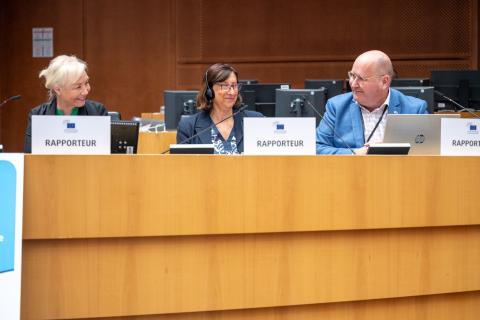
'Preparing for crises means strengthening the ability of our democracies to face new global challenges without compromising their fundamental values. Only a Europe firmly anchored in peace, freedom and democratic participation can ensure lasting resilience and citizens’ trust,' stressed the rapporteurs of the opinion, Tomas Arvidsson, Giulia Barbucci and Ariane Rodert.
Jessika Bohr from the Swedish Ministry of Defence said: 'We find ourselves in a new security reality where the security situation in Europe is dire. The threats we face are complex, cross border and increasingly antagonistic. In this context, preparedness is not optional. It is essential.'
Magali Mourlon from the Red Cross EU Office, warned: 'Societal preparedness needs to take into account the fact that society is not homogeneous, and we must leave no one behind.'
'Societies are not made resilient by regulations alone. They are resilient when citizens, volunteers, youth workers, civil society organisations and communities are empowered and recognised as part of Europe's preparedness fabric,' said Piotr Sadowski, Secretary-General of Volonteurope.
In the opinion, the EESC backed 'preparedness by design' across EU policies, meaning that preparedness must be built into the fabric of laws. At the same time, the EU and national governments must also keep investing in social cohesion and progress, which are vital to prevent and resolve conflicts. The EESC also asked the Commission to clarify who does what at EU, national and local levels and to stick to a firm rollout timetable.
On financing, the EESC flagged a gap: the Strategy asks a lot of Member States without spelling out what funding is available. Stable, long-term financing is essential without undermining key EU policies such as agriculture, cohesion and the Solidarity Fund. (ll)