Le Semestre européen 2026 : stimuler la compétitivité, la croissance durable et la résilience sociale dans un cadre budgétaire stratégique
Location
évènement en ligne
Belgium
Le groupe «Semestre européen» du CESE a pris l’initiative de réunir des intervenants en provenance des institutions de l’Union européenne, de la société civile organisée, des États membres et d’instituts de recherche à l’occasion de sa conférence annuelle qui se tiendra le mardi 30 juin 2026.
Le bénévolat joue un rôle essentiel dans la construction de sociétés résilientes et inclusives, mieux préparées aux défis actuels et futurs. Cette audition publique réunira des acteurs institutionnels, des organisations de la société civile, des partenaires sociaux et des experts afin de réfléchir au rôle que peut jouer le bénévolat dans le cadre d’une approche globale de la préparation (préconisée par la Commission européenne). Les discussions alimenteront l’Avis du CESE (SOC/864) relatif à ce sujet.
L’agenda et toutes les informations concernant cette session plénière seront disponibles 8 jours avant la date de l’événement. Vous pourrez suivre les débats en web streaming. Web streaming
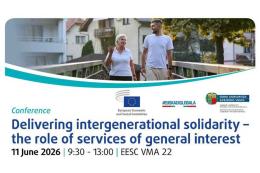
This conference will serve as a platform to showcase the societal and political significance of public services in promoting intergenerational solidarity, providing concrete action points for policymakers and practitioners. The aim is to broaden the debate and to serve as a constructive contribution to the development and refinement of the Intergenerational Fairness Strategy announced by the European Commission, to be adopted in the second quarter of 2026.
Reset and Recharge: All-island contributions to a resilient EU-UK relationship
Event type
Conference
Location
Europe House - 5 Balfe Street, Dublin, Ireland
Dublin
Ireland
The EU-UK Follow-Up Committee of the European Economic and Social Committee (EESC) is pleased to announce that the Annual All-Island Stakeholder Forum will be held in Dublin on 10th June 2026. This forum is the second of its kind, the first having been held in Dundalk last year.
This year’s forum is titled: ‘Reset and Recharge: All-island contributions to a resilient EU-UK relationship’. It is organised in collaboration with an Advisory Group of representative organisations from the three ‘pillars’ of the EESC – workers, employers and civil society organisations – from both jurisdictions.*
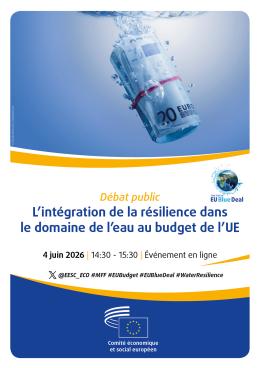
L'intégration de la résilience dans le domaine de l'eau au budget de l'UE est un sujet d’actualité pour garantir l’avenir de l’eau en Europe. Découvrez comment des investissements européens plus judicieux peuvent renforcer la résilience, la durabilité et la préparation en matière d’eau, et comment définir les priorités de financement des programmes de demain dans le cadre du prochain cadre financier pluriannuel de l’UE.
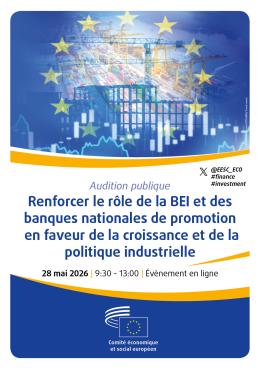
Cette audition publique réunira des décideurs politiques et des parties prenantes de la société civile afin de discuter de la manière dont les banques publiques peuvent mieux soutenir la politique industrielle de l’UE, l’innovation, l’expansion des entreprises de l’UE et, en fin de compte, la croissance économique.
Cette audition publique aura pour objectif de présenter et d’examiner la stratégie de la Commission européenne sur l'équité intergénérationnelle, un nouveau cadre stratégique visant à garantir que les décisions actuelles sont prises en tenant compte de l’avenir, en garantissant un juste équilibre entre les avantages et les charges pour toutes les générations. Cette manifestation réunira des acteurs institutionnels clés, des organisations de la société civile, des partenaires sociaux et des experts afin de réfléchir aux priorités de la stratégie et de contribuer à l’élaboration de l’avis du CESE (SOC/868).
L'événement sera retransmis en ligne (EN, original). Aucune inscription n'est nécessaire et la participation est gratuite.
Suivez nous sur X: @EESC_SOC
Posez vos questions aux intervenants via Sli.do avec le code de l'événement: #IntergenStrategy
This hearing will bring together representatives from EU institutions, organised civil society and voices from candidate countries to gather input for the EESC’s opinion on enlargement and climate.