Europe’s social model depends on a strong and competitive economy. Quality jobs are created and sustained by economically successful enterprises operating in a favourable business environment — and European businesses are committed to delivering exactly that when the conditions allow for it. However, companies cannot offer quality employment if they are over-regulated, under-capitalised and unable to grow. Competitiveness, productivity growth, innovation and skills are therefore not separate from the social agenda: they are the foundation of Europe’s resilience, prosperity and social model.
Europe faces a structural challenge related to the affordability of housing, exacerbated by increased exposure to international risk factors. It is important to identify the root causes of this situation to be able to develop solutions that will guarantee effective access to affordable housing. Repeated crises at the global level – health, energy, geopolitical – have reminded us that, as with any good of service, the price of housing is regulated by supply and the ability of demand to compensate for that supply. The number of housing units granted building permits fell by 25% in five years, from 2 million permits to 1,5 million. At the same time, the cost of construction materials rose by around 30%, influenced by the cost of energy and supply shortages.
In 2023 the EU launched its European Economic Security Strategy, committing to performing a thorough review of the possibilities for strengthening its economic security, driven by the wide-scaled geopolitical and geo-economical changes. Building and deepening political and economic alliances with like-minded states and regions, sharing similar European values, seems to be the only viable strategy. In today’s growingly connected, digital, AI-governed world, the mutual interdependencies neither can be ignored, nor can they be framed within protectionist policies and measures. Therefore, the recent trade agreements with Mercosur, India, Canada, Australia and African Union states are right enough and must be further developed.
The data gathered in our evaluation clearly shows that direct payments and the redistributive measures of the CAP act as an essential safety net to reduce farmers’ income instability. For this reason, the EESC position is firm: in the long term, it is essential to maintain a CAP with a clearly differentiated two-pillar structure. The first pillar must continue to protect direct income support and market stability, while the second pillar must focus on integrated rural development.
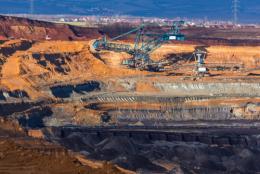
With geopolitical tensions rising and global supply chains under strain, RESourceEU has become a geopolitical necessity. The plan commits €3 billion in funding over the next 12 months, mobilised from EU budgets, the European Investment Bank (EIB), and programs like the Innovation Fund, Battery Booster, and Horizon Europe. Its ambition? To halve the EU’s dependence on single external suppliers by 2029 while boosting domestic recycling, mining, and strategic partnerships.
One of the Resolution’s central recommendations is therefore to strengthen the involvement of social partners and civil society organisations throughout the European Semester cycle. Consultation cannot remain a procedural obligation. It must become a genuine driver of policy success.
The 2026 United Nations Water Conference comes at a decisive moment for global water governance. As increased demand from economic activities, unsustainable water use, population growth and climate change put increasing pressure on hydrological resources, water has become a central challenge for societal and economic resilience, social stability and sustainable development. In its dedicated opinion, the EESC outlines a strategic vision for global action, based on its work on the EU Blue Deal and informed by the experience of employers, workers and organised civil society.
On 29 April 2026, Ms Antje Gerstein, member of the EESC Employers' Group, was elected President of the Single Market, Production and Consumption (INT) section. In this interview is her take on her new mandate.
The Industrial Accelerator Act (IAA) aims to support industrial transformation, strengthen strategic value chains, and accelerate the deployment of low-carbon technologies, but its implications and impact across different sectors raise concerns.
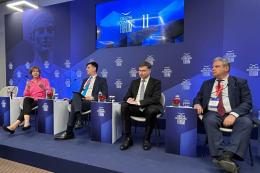
At this year’s Delphi Economic Forum, an EESC Employers' Group delegation, led by President Sandra Parthie and composed of members Winand Quaedvlieg, Marcin Nowacki, Michal Pinter, Kristi Sober, and Katalin Sule, joined political, business, and academic leaders to talk about economic growth, geopolitics, and sustainability.