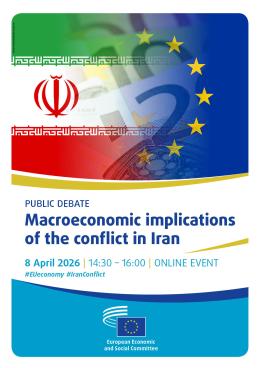
Public Debate | 8 April 2026 | 14:30-16:00 | Online Event Rising tensions and the renewed conflict in Iran adds new volatility to an already fragile global economic environment. Against a backdrop of geopolitical fragmentation, energy market uncertainty and slowing growth, understanding the macroeconomic implications of this conflict for Europe has become increasingly urgent. The Section for Economic and Monetary Union and Economic and Social Cohesion (ECO) of the EESC will organise a public debate to examine the broader macroeconomic consequences of the conflict in Iran for the European economy.
To celebrate Bulgaria's accession to the euro zone, the ECO section organises a public debate to discuss Bulgaria's road to the euro, its prospects as part of the common currency area, and the outlook for the euro area in a world of geopolitical challenges, inflationary pressures and economic uncertainties.
Public debate in the ECO Section on the Latest twists and turns on the road to the next Multiannual Financial Framework in the framework of the opinion ECO/682 Multiannual financial framework 2028-2034.
Public debate on Defence-related investments in the EU budget in the context of the new geopolitical order, to contribute to the final report of the EESC´s ad hoc group on the new geopolitical order, and in the framework of the opinion ECO/679 - Defence-related investments in the EU budget.
Lessons learned and a new Inflation Governance Framework
Event type
Conference
Location
room VMA 22, Van Maerlant 2
Brussels
Belgium
On Wednesday, 3 September 2025, from 14:00 – 17:30 (CET), the European Economic and Social Committee (EESC) will host an event organised by the Foundation for European Progressive Studies, in cooperation with Fondazione Pietro Nenni and tasc, discussing lessons learned from the recent inflation episode and the new inflation governance framework that needs to be developed to prevent or mitigate the supply side inflation shocks in the future.
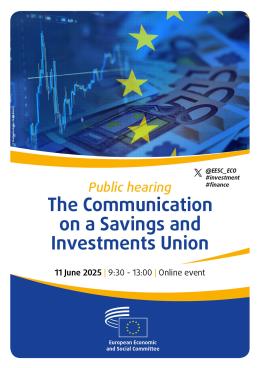
The EESC organises a public hearing on the Communication on a Savings and Investments Union. It will gather together institutions, industry and civil society stakeholders, and will discuss on how to deliver opportunities for households, businesses and the whole EU economy.
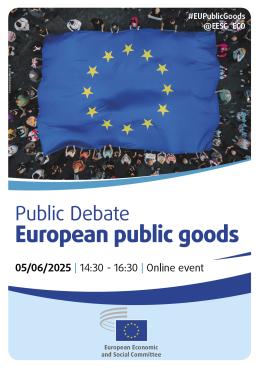
In a context such as the one that Europe is experiencing, characterised by multiple crises, it is appropriate to promote a reflection on European public goods and on fundamental political priorities capable of ensuring the sustainable growth of the EU and the well-being of its citizens. This reflection gets ever more important in view of the upcoming negotiations on the next European Multiannual Financial Framework for the period post 2027.
Ministry of Economic Development and Technology, Warsaw (Poland)
In recent years, our businesses have operated in less stable, less predictable and less safe global environment. Yet, at the same time, global economic integration has never been deeper. This paradox is particularly evident in the complex interplay between the EU, US, and China. The Extraordinary Employers' Group meeting in Warsaw will seek to align the vision with tangible actions, with the aim to improve competitiveness and resilience, strengthening the EU open strategic autonomy.