This document presents the five priorities of the EESC Employers’ Group and the policy actions for policymakers to improve the business environment, and thereby the EU’s competitiveness and conditions for creating prosperity for citizens.
The European Semester increasingly relies on Member States’ ability to implement reforms and investments. Delays often stem not from a lack of funding or policy guidance, but from administrative bottlenecks, limited technical expertise, excessive red tape, complex procedures or insufficient coordination across different levels of national government. The thematic debate will therefore examine how the European Semester could better assess and monitor administrative capacity at national level, as well as whether administrative reform should become a more prominent element in the country-specific recommendations. It will also examine what lessons can be drawn from the implementation of the national recovery and resilience plans, whether instruments such as the Technical Support Instrument could play a stronger role in supporting reforms. Finally, the aim will be to understand how these instruments can contribute, in the long term, to strengthening the capacity building of national administrations and stakeholders.
Public debate in the ECO Section on the "The international role of the euro: A European safe asset for a new geopolitical era?". This public debate will explore the opportunities and challenges associated with strengthening the international role of the euro and discuss the economic, financial and geopolitical arguments for and against the creation of a European safe asset.
The insurance protection gap against natural disasters is growing in the EU. In this context, this public hearing creates a space for debate with regulators and organisations on existing evidence, the need for action at EU and local levels, and on specific policy proposals. The takeaways will feed the discussions on our opinion ‘Towards a European system of natural disaster risk management for the EU insurance sector’.
Together the Information Report ECO/711 and the Resolution ECO/712 are a continuation of the European Semester Group's (ESG) work to consult annually national economic and social councils, social partners and civil society organisations from EU Member States on reform and investment proposals made in the context of the European Semester and their implementation in the Member States.
The Information Report aims to collect the views of social partners and civil society organisations in the Member States on the reform and investment proposals and their implementation, in particular those indicated in the 2026 Country-Specific Recommendations.
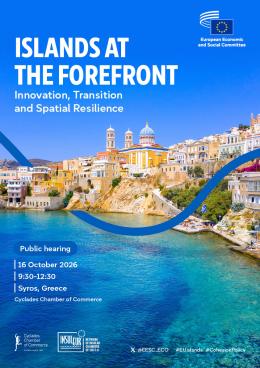
As part of the preparation of the EESC opinion on an EU Strategy for Islands, the European Economic and Social Committee, in cooperation with INSULEUR, will hold a public hearing in Syros, at the heart of the Cyclades. The hearing aims to bring together local and regional authorities, organised civil society, businesses, academia and citizens to exchange views on both the challenges and the untapped opportunities facing Europe's islands.
As Europe seeks to strengthen its competitiveness in an increasingly fragmented global economy, the challenge is not only to boost productivity and innovation, but also to preserve the foundations of its social market economy. This high-level conference will examine how the EU can mobilise savings and investment, maintain sustainable public finances, and deepen Economic and Monetary Union to support long-term growth, resilience and convergence.