Euroopa roheline kokkulepe

This page is also available in:

11. detsembril 2019 esitles Euroopa Komisjon Euroopa rohelist kokkulepet, korrates ELi võetud kohustust tegeleda kliima- ja keskkonnaprobleemidega, mis on selle põlvkonna jaoks määrava tähtsusega ülesanne. Euroopa rohelise kokkuleppe eesmärk on muuta EL nüüdisaegseks, ressursitõhusaks ja konkurentsivõimeliseks majanduseks, tagades et

  • kasvuhoonegaaside netoheide kaob 2050. aastaks;
  • majanduskasv muutub ressursikasutusest sõltumatuks;
  • ühtegi inimest ega kohta ei jäeta kõrvale.

Euroopa rohelise kokkuleppe täitmiseks viib EL ellu ulatusliku algatuste paketi, mis hõlmab poliitilisi ja seadusandlikke ettepanekuid ning rahastamisvahendite väljatöötamist ja ajakohastamist.

Komitee on kutsunud üles sõlmima rohelist ja sotsiaalset kokkulepet, rõhutades tihedat seost rohelise kokkuleppe ja sotsiaalse õigluse vahel. Selleks et homsed kestlikud ja konkurentsivõimelised ettevõtted saaksid edeneda tervislikus keskkonnas, on oluline kuulda kõigi sidusrühmade häält.

Euroopa rohelises kokkuleppes pandi suurt rõhku investeeringutele ning rohe- ja kestliku ülemineku rahastamisele. Roheline kokkulepe on Euroopa peamine vahend COVID-19 pandeemiast väljumiseks. Euroopa rohelist kokkulepet rahastatakse ühe kolmandikuga taasterahastu „NextGenerationEU“ taastekava 1,8 triljoni euro suurustest investeeringutest ja ELi seitsmeaastasest eelarvest. Rahastamisvõimaluste suurendamise eesmärk on muuta kriis võimaluseks Euroopa tulevik ümber kujundada.

Komiteel on oluline roll Euroopa rohelise kokkuleppe algatuste ja meetmete rakendamise järelevalves. Komitee koostab arvamusi ja korraldab tegevusi (vt selle lehekülje vasakus servas olevat kõrvalmenüüd) eesmärgiga tagada, et ELi institutsioonid võtavad arvesse organiseeritud kodanikuühiskonna seisukohti ning rohelise kokkuleppe algatused on kooskõlas majandusliku, sotsiaalse ja ühiskondliku olukorraga kohapeal.

Kuna Euroopa roheline kokkulepe on olemuselt valdkonnaülene ja kõikehõlmav, käsitlevad seda kõik komitee sektsioonid ja CCMI.
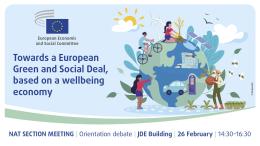
  • In the context of the upcoming European elections in June 2024, the high-level discussion at the NAT section meeting on 26 February will contribute to set the agenda of the new Commission. Building on previous EESC opinions and events on "The sustainable economy we need" and "Beyond GDP measures", the debate will feed into the own-initiative opinion on A Blueprint for a European Green and Social Deal, based on a wellbeing economy.

  • Event type
    Conference

    The event will present a grassroots and local government perspective on the European Green Deal, with ECOLISE and ICLEI Europe sharing insights into the handprint of community-led initiatives and local governments in addressing the planetary crisis. 

  • Extraordinary meeting of the Civil Society Organisations' Group
    Event type
    Conference

    Registration is now closed. We invite you to follow the conference via webstream.

  • Event type
    Public hearing

    The purpose of this hearing was to contribute to the EESC opinion and to the debate on the rethinking of the internal market in light of the acceleration of the twin transitions and on crafting a European Industrial Strategy that strenghen EU industries.

  • The sustainable economy we need - With Executive Vice-President Timmermans

    Following the success of the previous Youth Climate and Sustainability Round Tables, the EESC will host the fourth EU Youth Round Table on Tuesday 18 July, 10:30-11:30 CEST. Frans Timmermans, Executive Vice-President for the European Green Deal, will participate in the event and will engage with the youth representatives on the topic: the sustainable economy we need for a successful implementation of the European Green and Social Deal.

  • Extraordinary meeting of the Civil Society Organisations' Group in the framework of the Czech Presidency

    On 11 October 2022, the Civil Society Organisations' Group of the European Economic and Social Committee will hold a conference under the Czech Presidency of the Council of the EU in Ostrava, Czech Republic, on Reinventing the Moravian-Silesian Region in search of a socially just transition. This is an in-person event that will be streamed online.

  • How to speed up the Shift to Renewable Energy in Europe
    Event type
    Conference

    The Sustainable Development Observatory of  the European Economic and Social Committee (EESC) will host an online conference with the aim to assess the future development of photovoltaic systems and wind power plants and discuss how to build up the European renewable industry to avoid creating new dependencies. 

  • Extraordinary Workers' Group meeting

    The Workers' Group is organizing an extraordinary meeting in Prague focusing on the programme and priorities of the Czech EU Presidency and on the role of the social dialogue within the green transition.

  • The Moravian-Silesian Region as a testing ground

    While the EU is increasing its ambitions under the "Fit for 55" package, Europe's coal regions in transition are facing unprecedented structural change, exacerbated by the major energy crisis resulting from Russia's invasion of Ukraine and the damage caused by the COVID -19 pandemic.

  • Event type
    Debate

    In view of the upcoming Stockholm+50 conference and with the European Green Deal in mind, this event will explore ways of accelerating action for a better future on a healthy planet.