Pacto Verde Europeo

This page is also available in:

El 11 de diciembre de 2019, la Comisión Europea puso en marcha el Pacto Verde Europeo, que refuerza el compromiso de la UE de hacer frente a los retos relacionados con el clima y el medio ambiente, que es la misión que define a esta generación. El objetivo del Pacto Verde Europeo es transformar la UE en una economía moderna, eficiente en el uso de los recursos y competitiva que garantice que:

  • hayan dejado de producirse emisiones netas de gases de efecto invernadero en 2050;
  • el crecimiento económico no dependa del uso de recursos;
  • ningún territorio ni persona se queden atrás.

Para cumplir el Pacto Verde Europeo, la UE está aplicando un amplio paquete de iniciativas que incluye propuestas políticas y legislativas y el desarrollo y la modernización de los instrumentos de financiación.

El CESE viene reclamando un «Pacto Verde y Social», subrayando el estrecho vínculo entre el Pacto Verde y la justicia social. Es esencial escuchar a todas las partes interesadas para fomentar las empresas sostenibles y competitivas del mañana en un entorno saludable.

El Pacto Verde Europeo hizo especial hincapié en la inversión y la financiación de la transición ecológica y sostenible. El Pacto Verde es la principal vía de recuperación de Europa tras la pandemia de COVID-19. El Pacto Verde Europeo se financia mediante un tercio de las inversiones por valor de 1,8 billones EUR del plan de recuperación NextGenerationEU y el presupuesto para siete años de la UE. Este impulso de las oportunidades de financiación tiene por objeto convertir la crisis en una oportunidad transformadora para el futuro de Europa.

El CESE desempeña un papel crucial en el seguimiento de la aplicación de las iniciativas y medidas del Pacto Verde Europeo. El CESE elabora dictámenes y organiza actividades (véase el menú lateral izquierdo de esta página) para garantizar que las instituciones de la UE tengan en cuenta los puntos de vista de la sociedad civil organizada y las iniciativas del Pacto Verde sean coherentes con las circunstancias económicas, sociales y cívicas sobre el terreno.

Debido a su carácter transversal y global, el Pacto Verde Europeo está cubierto por todas las secciones del CESE y la CCMI.
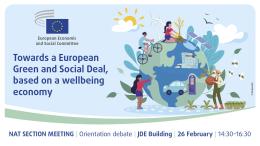
  • In the context of the upcoming European elections in June 2024, the high-level discussion at the NAT section meeting on 26 February will contribute to set the agenda of the new Commission. Building on previous EESC opinions and events on "The sustainable economy we need" and "Beyond GDP measures", the debate will feed into the own-initiative opinion on A Blueprint for a European Green and Social Deal, based on a wellbeing economy.

  • Event type
    Conference

    The event will present a grassroots and local government perspective on the European Green Deal, with ECOLISE and ICLEI Europe sharing insights into the handprint of community-led initiatives and local governments in addressing the planetary crisis. 

  • Extraordinary meeting of the Civil Society Organisations' Group
    Event type
    Conference

    Registration is now closed. We invite you to follow the conference via webstream.

  • Event type
    Public hearing

    The purpose of this hearing was to contribute to the EESC opinion and to the debate on the rethinking of the internal market in light of the acceleration of the twin transitions and on crafting a European Industrial Strategy that strenghen EU industries.

  • The sustainable economy we need - With Executive Vice-President Timmermans

    Following the success of the previous Youth Climate and Sustainability Round Tables, the EESC will host the fourth EU Youth Round Table on Tuesday 18 July, 10:30-11:30 CEST. Frans Timmermans, Executive Vice-President for the European Green Deal, will participate in the event and will engage with the youth representatives on the topic: the sustainable economy we need for a successful implementation of the European Green and Social Deal.

  • Extraordinary meeting of the Civil Society Organisations' Group in the framework of the Czech Presidency

    On 11 October 2022, the Civil Society Organisations' Group of the European Economic and Social Committee will hold a conference under the Czech Presidency of the Council of the EU in Ostrava, Czech Republic, on Reinventing the Moravian-Silesian Region in search of a socially just transition. This is an in-person event that will be streamed online.

  • How to speed up the Shift to Renewable Energy in Europe
    Event type
    Conference

    The Sustainable Development Observatory of  the European Economic and Social Committee (EESC) will host an online conference with the aim to assess the future development of photovoltaic systems and wind power plants and discuss how to build up the European renewable industry to avoid creating new dependencies. 

  • Extraordinary Workers' Group meeting

    The Workers' Group is organizing an extraordinary meeting in Prague focusing on the programme and priorities of the Czech EU Presidency and on the role of the social dialogue within the green transition.

  • The Moravian-Silesian Region as a testing ground

    While the EU is increasing its ambitions under the "Fit for 55" package, Europe's coal regions in transition are facing unprecedented structural change, exacerbated by the major energy crisis resulting from Russia's invasion of Ukraine and the damage caused by the COVID -19 pandemic.

  • Event type
    Debate

    In view of the upcoming Stockholm+50 conference and with the European Green Deal in mind, this event will explore ways of accelerating action for a better future on a healthy planet.