
European Economic
and Social Committee
The EESC calls for an Islands Pact to set out the EU's strategy for islands
The European Economic and Social Committee (EESC) believes that the challenges faced by EU islands are not adequately addressed by the EU's sectoral policies. Instead of being treated as peripheral territories, islands should be recognised as frontline regions for Europe.
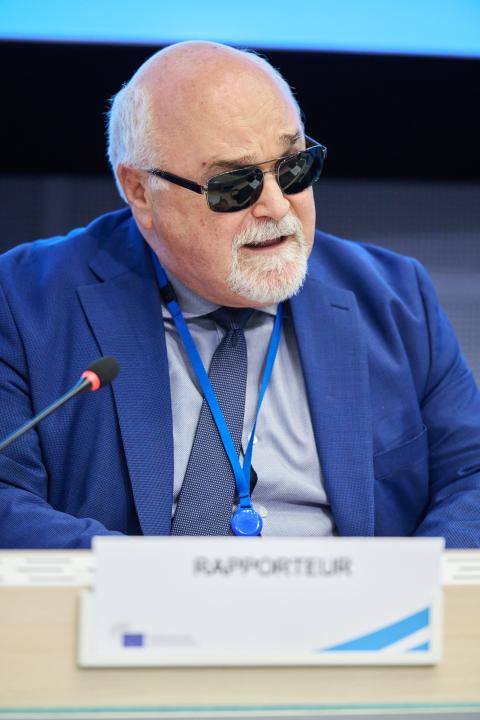
On 18 February, the EESC adopted an exploratory opinion, The Island Dimension in European Cohesion, Competitiveness and Sustainable Development Policies, which had been requested by the Cyprus Presidency of the Council of the EU. As its rapporteur Ioannis Vardakastanis stressed, this opinion could inform a new strategy for islands and coastal communities, which the European Commission is expected to unveil in 2026.
The EU comprises a variety of island regions spanning the Mediterranean Sea, the Atlantic Ocean, the North Sea and the Baltic Sea. It also encompasses outermost regions in the Caribbean and the Indian Ocean. Finland's Lakeland region, with its thousands of forested islands, is the largest lake region in Europe.
These island and lake regions play a key role in ensuring Europe’s strategic autonomy with regard to defence, energy security, and access to critical resources. Furthermore, they are vital for the EU’s blue economy and climate resilience. It is therefore important to ensure that island communities can prosper while reinforcing Europe’s strategic interests and regional cohesion.
At the EESC debate, Mr Vardakastanis thus emphasised that the EU requires a 'systemic shift' to address the needs of islands. As the EESC stated in its opinion, this would entail the development of a dedicated EU Islands Strategy (the Islands Pact), supported by a clear legislative framework (the Islands Act) containing an 'insularity clause'. This clause would systematically integrate the specific needs and constraints of islands into Union policies on cohesion, transport, energy, state aid, the environment, and maritime affairs.
The EESC has stressed that, although EU islands are at the forefront of Europe's sovereignty, resilience and capacity for innovation, they continue to be impacted by persistent structural disadvantages. This leads to a range of challenges, including isolation, melting ice, high transport and energy costs, housing shortages, labour shortages and excessive dependence on tourism.
The EESC reiterated in its opinion that improving connectivity and infrastructure in island territories is essential to achieving territorial cohesion. This requires enhanced transport links and public mobility systems, stronger digital connectivity, and more resilient energy grids that prioritise decarbonisation and energy autonomy. Additionally, island regions must diversify their economies by fostering a sustainable and competitive blue economy that builds on their unique assets, such as marine resources, renewable energy potential, tourism, cultural heritage and creative industries.
The 'insularity clause' should also apply to future National and Regional Partnership Plans (in the context of the Multiannual Financial Framework 2028–34) and be translated into measures relating to housing, transport decarbonisation, water and waste management, climate adaptation, access to healthcare and economic opportunities. The EESC called for the formal integration of monitoring, foresight and participatory governance into island policies, proposing a regular island implementation report to track key demographic, economic, social and environmental indicators. The EESC emphasised the importance of the active involvement of local authorities, stakeholders, academia and local communities throughout the design, implementation and evaluation of policies.
Work organisation
Recommended for you
„Sinu Euroopa, Sinu arvamus“ 2023: noored soovivad läbipaistvamat, digitaalsemat ja lihtsamat ELi
News
23. ja 24. märtsil korraldas Euroopa Majandus- ja Sotsiaalkomitee 14. korda ürituse „Sinu Euroopa, Sinu arvamus“. Üritus tõi Brüsselisse 105 õpilast 35 koolist kõigist 27…
Algab kandideerimine Euroopa Majandus- ja Sotsiaalkomitee kodanikuühiskonna auhinnale, mille teemaks on vaimne tervis
News
Kodanikuühiskonna organisatsioonid, üksikisikud ja eraettevõtted saavad nüüd esitada oma mittetulunduslikke projekte, et konkureerida Euroopa Majandus- ja Sotsiaalkomitee auhinnale, mis on pühendatud…
Valimised 2024. aasta juunis: Euroopa Majandus- ja Sotsiaalkomitee kutsub eurooplasi üles hääletama ühtse ja demokraatliku Euroopa poolt
News
Uue Euroopa Parlamendi valimistel on palju kaalul, sest demokraatia on nõrgenemas kogu maailmas, desinformatsioon on laialt levinud ja rahulolematus kasvab, kuna inflatsioon kiireneb ja sõjaoht…
TENi sektsiooni esimees Baiba Miltoviča ja Euroopa Regioonide Komitee raportöör Andres Jaadla kirjutavad alla elamumajandust käsitlevale deklaratsioonile
News
14. novembril 2024 allkirjastatud ühisavalduses kutsuvad Euroopa Majandus- ja Sotsiaalkomitee transpordi, energeetika, infrastruktuuri ja infoühiskonna sektsiooni (TEN) esimees Baiba…
EL peab transpordisektori CO2 heite vähendamiseks viivitamatult keskenduma saastevabale vesinikule
News
Eestis toimunud konverentsil rõhutati, et vähese CO2 heitega vesinik on energiasüsteemi eduka ümberkujundamise põhielement, mille potentsiaali arendamiseks on aga vaja taristut ja rahastamist.Ürituse…