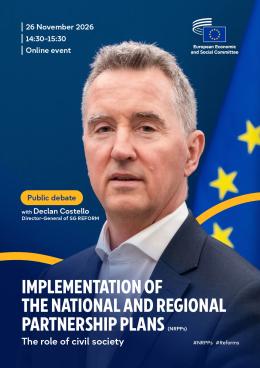
The ECO Section will hold a policy debate with Declan Costello, Director-General of SG REFORM, on the implementation of the National and Regional Partnership Plans (NRPPs) under the next EU Multiannual Financial Framework (2028–2034). The discussion will focus on the role of organised civil society in the design, implementation and monitoring of the NRPPs, with particular emphasis on safeguarding the partnership principle and multilevel governance.
Υπό επεξεργασία (updated on 22/09/2026) - Bureau decision date: 22/09/2026
Έγγραφα αναφοράς
NAT/1008-EESC-2026
Plenary session number
610
-
Download format:
Download — Γνωμοδότηση της ΕΟΚΕ: Amendment of the European maritime, fisheries and aquaculture fund (EMFAF) for simplification and transposition of WTO agreement
In this overview the European Economic and Social Committee (EESC) shares its opinions on the European Commission’s proposals for the Multiannual Financial Framework (MFF) 2028-2034, bringing together the perspectives of organised civil society on the future direction of the EU budget.
rue Belliard 101, Jacques Delors building, room JDE 63, 9:30-11:00
Brussels
Belgium
EESC, room JDE 63, 9:30-11:00
The policy debate brings together stakeholders to assess how National and Regional and Partnership Plans will work in practice. In a workshop setting connected to the European Economic and Social Committee, participants from civil society, social partners and institutions will exchange perspectives on transparency, inclusiveness and impact. The discussion aims to highlight gaps, share best practices and strengthen the role of organised civil society in shaping and monitoring the implementation of NRPPs in the EU.
Public debate in the ECO Section on the The Multiannual Financial Framework after 2027 - Assessing progress and outstanding challenges. The event will take stock of developments in the negotiations since the Commission presented their proposals for the next Multiannual Financial Framework and discuss outstanding challenges.
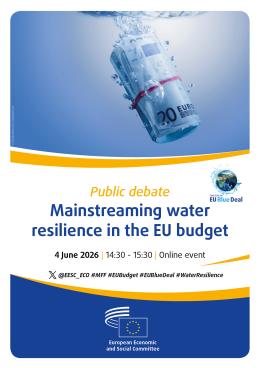
Mainstreaming Water Resilience in the EU Budget is a timely discussion on securing Europe’s water future. Discover how smarter EU investments can strengthen water resilience, sustainability, and preparedness, and how we should shape tomorrow’s funding priorities across programmes in the context of the EU´s next Multiannual Financial Framework.
"Cohesion policy 2028–2034: A new fund, a new framework, a new role for civil society?" brings together EU institutions, social partners and civil society representatives to reflect on the future of cohesion policy in the next Multiannual Financial Framework. The hearing explores proposals for reforming cohesion funding and governance, assesses the implications of the new framework through the National and Regional Partnership Plans and examines how civil society organisations can play a stronger role in the design, implementation and monitoring of cohesion policy. The discussion aims to identify how cohesion policy can continue to deliver territorial, social and economic cohesion while responding to new challenges and transitions facing the European Union.