European Economic
and Social Committee
European Economic
and Social Committee
The European Economic and Social Committee (EESC) is the voice of organised civil society in Europe.
Find out more about its role and structure at http://www.eesc.europa.eu/en/about
The EESC issues between 160 and 190 opinions, evaluation and information reports a year.
It also organises several annual initiatives and events with a focus on civil society and citizens’ participation such as the Civil Society Prize, the Civil Society Days, the Your Europe, Your Say youth plenary and the ECI Day.
Find the latest EESC opinions and publications at http://www.eesc.europa.eu/en/our-work/opinions-information-reports/opinions and http://www.eesc.europa.eu/en/our-work/publications-other-work/publications respectively.
The EESC is active in a wide range of areas, from social affairs to economy, energy and sustainability.
Learn more about our policy areas and policy highlights at http://www.eesc.europa.eu/en/policies
The EESC holds nine plenary sessions per year. It also organises many conferences, public hearings and high-level debates related to its work.
Find out more about our upcoming events at http://www.eesc.europa.eu/en/agenda/our-events/upcoming-events
Here you can find news and information about the EESC'swork, including its social media accounts, the EESC Info newsletter, photo galleries and videos.
Read the latest EESC news http://www.eesc.europa.eu/en/news-media/news and press releases http://www.eesc.europa.eu/en/news-media/press-releases
The EESC brings together representatives from all areas of organised civil society, who give their independent advice on EU policies and legislation. The EESC's326 Members are organised into three groups: Employers, Workers and Various Interests.
Find out more about our Members and groups at http://www.eesc.europa.eu/en/members-groups
The EESC has six sections, specialising in concrete topics of relevance to the citizens of the European Union, ranging from social to economic affairs, energy, environment, external relations or the internal market.
Find out more at http://www.eesc.europa.eu/en/sections-other-bodies
EHSV se jednoznačně zasazuje o dekarbonizaci energetického systému EU a vyzývá tvůrce politik EU, aby se zabývali důsledky desítky let trvající energetické závislosti.
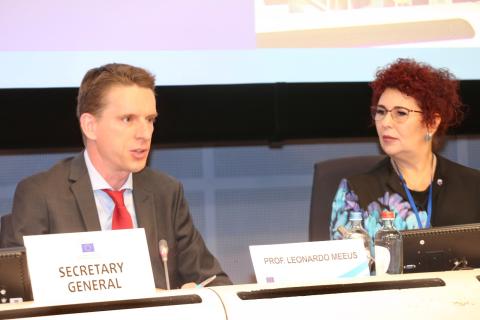
Těmito slovy zahájila předsedkyně EHSV Christa Schweng diskusi o transformaci energetiky v EU a strategické autonomii, která se konala v rámci plenárního zasedání dne 26. října 2022 a jíž se zúčastnil profesor Leonardo Meeus z Evropského univerzitního institutu ve Florencii.
„Musíme usilovat o takovou ekologickou transformaci, jejímuž tempu budou stačit podniky a společnosti, a nabídnout doplňující opatření, díky nimž bude Evropa konkurenceschopná v globálním měřítku a která v Evropě umožní inovace“, prohlásila Christa Schweng. „EU může snížit svou závislost na dovážené energii tím, že bude rozvíjet svou lokální kapacitu pro výrobu energie z obnovitelných zdrojů. K tomu je však třeba poskytnout investiční pobídky.“
Profesor Meeus se věnoval otázce reforem unijního trhu s elektřinou, které navrhla Evropská komise. Uvedl, že trh s elektřinou, který jsme vytvořili v průběhu posledních 20 let, může přetrvat i do budoucna, pokud jej zkombinujeme s novými nástroji, které jej doplní a které zapojí spotřebitele a zmodernizují sítě.
Diskuse byla uspořádána v návaznosti na přijetí stanoviska Strategická vize pro transformaci energetiky v zájmu dosažení strategické autonomie EU, jež vypracovali Thomas Kattnig, Lutz Ribbe a Tomasz Andrzej Wróblewski.
Toto stanovisko stanoví vizi EHSV pro transformaci energetiky a její úlohu při dosahování strategické autonomie EU. Klade přitom důraz na urychlení dekarbonizace, snížení závislosti na dovozu energií, zvýšení spoluodpovědnosti komunit a podniků a na podporu zranitelných domácností. (mp)