European Economic
and Social Committee
European Economic
and Social Committee
The European Economic and Social Committee (EESC) is the voice of organised civil society in Europe.
Find out more about its role and structure at http://www.eesc.europa.eu/en/about
The EESC issues between 160 and 190 opinions, evaluation and information reports a year.
It also organises several annual initiatives and events with a focus on civil society and citizens’ participation such as the Civil Society Prize, the Civil Society Days, the Your Europe, Your Say youth plenary and the ECI Day.
Find the latest EESC opinions and publications at http://www.eesc.europa.eu/en/our-work/opinions-information-reports/opinions and http://www.eesc.europa.eu/en/our-work/publications-other-work/publications respectively.
The EESC is active in a wide range of areas, from social affairs to economy, energy and sustainability.
Learn more about our policy areas and policy highlights at http://www.eesc.europa.eu/en/policies
The EESC holds nine plenary sessions per year. It also organises many conferences, public hearings and high-level debates related to its work.
Find out more about our upcoming events at http://www.eesc.europa.eu/en/agenda/our-events/upcoming-events
Here you can find news and information about the EESC'swork, including its social media accounts, the EESC Info newsletter, photo galleries and videos.
Read the latest EESC news http://www.eesc.europa.eu/en/news-media/news and press releases http://www.eesc.europa.eu/en/news-media/press-releases
The EESC brings together representatives from all areas of organised civil society, who give their independent advice on EU policies and legislation. The EESC's326 Members are organised into three groups: Employers, Workers and Various Interests.
Find out more about our Members and groups at http://www.eesc.europa.eu/en/members-groups
The EESC has six sections, specialising in concrete topics of relevance to the citizens of the European Union, ranging from social to economic affairs, energy, environment, external relations or the internal market.
Find out more at http://www.eesc.europa.eu/en/sections-other-bodies
EØSU er engageret og fast besluttet, når det gælder om at dekarbonisere EU's energisystem, og opfordrer EU's politiske beslutningstagere til at tage hånd om konsekvenserne af årtiers energiafhængighed.
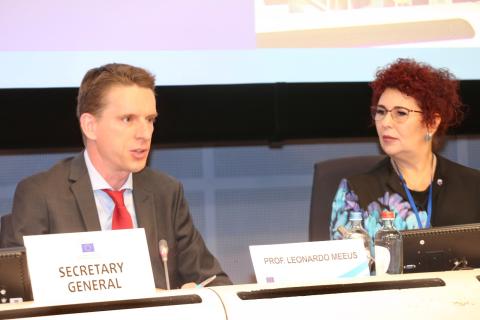
Med disse ord åbnede EØSU's formand Christa Schweng debatten om EU's energiomstilling og strategiske autonomi på plenarforsamlingen den 26. oktober 2022. EØSU havde inviteret professor Leonardo Meeus fra Det Europæiske Universitetsinstitut i Firenze.
"Vi er nødt til at gå videre med den grønne omstilling i et tempo, som virksomheder og samfund kan holde trit med, og træffe ledsageforanstaltninger, der gør det muligt for Europa at bevare sin globale konkurrenceevne og fremme innovation", fastslog Christa Schweng. "EU har potentialet til at gøre sig mindre afhængig af importeret energi ved at udbygge sin egen kapacitet til produktion af vedvarende energi, men det kræver de rette investeringsincitamenter."
Professor Leonardo Meeus henviste til de reformer af EU's elmarked, som Kommissionen har foreslået, og hævdede, at det elmarked, som vi har opbygget over de seneste 20 år, fortsat kan eksistere i fremtiden, så længe vi supplerer og kombinerer det med nye instrumenter til større forbrugerinddragelse og modernisering af nettene.
Debatten fandt sted i forbindelse med vedtagelsen af EØSU's udtalelse En strategisk vision for energiomstilling med henblik på at muliggøre EU's strategiske autonomi udarbejdet af Thomas Kattnig, Lutz Ribbe og Tomasz Andrzej Wróblewski.
I udtalelsen fremlægger EØSU sin vision for energiomstillingen og dennes rolle i opnåelsen af EU's strategiske autonomi med fokus på at fremskynde dekarboniseringen, gøre os mindre afhængige af energiimport, få større opbakning fra lokalsamfund og virksomheder samt hjælpe sårbare husholdninger. (mp)