
European Economic
and Social Committee
Civil society organisations at the helm of volunteer assistance to Ukrainian civilians
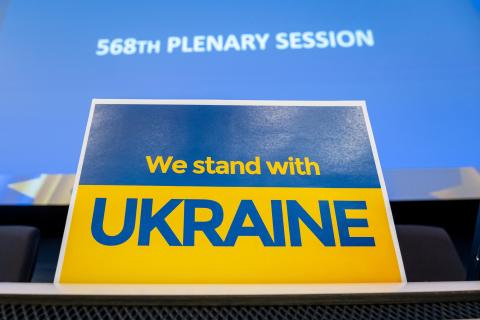
Civil society organisations need continued support for their assistance to Ukrainian people and refugees. This is of particular importance for organisations working in Ukraine and its neighbouring countries. National and EU authorities need a long-term strategy for refugees and volunteers.
Representatives of civil society organisations from five neighbouring countries spoke about their work at a recent meeting of the Diversity Europe Group of the European Economic and Social Committee (EESC). Their statements illustrated the crucial role that civil society organisations play in assisting people in this crisis. Many organisations adapted their activities overnight and are now closely cooperating with local and national authorities, international and partner organisations in Ukraine, and citizens. They provide missing services and complement the work of the public authorities.
Civil society organisations are active in every single country,
said Séamus Boland, president of the Diversity Europe Group, opening the debate. People are driving to Kyiv, are risking their lives bringing people from the most dangerous areas of Ukraine, bringing supplies, bringing relief.
But civil society organisations do not only provide relief items to Ukrainian people. They also offer transport and accommodation or provide people with relevant information.
People usually come bare-handed,
explained Paulina Gajownik from the Polish Scouting and Guiding Association. Railway stations are their first destination and this is where we come in. We manage thousands of volunteers, directing the refugees to overnight stay facilities, but also to private lodgings. We make sure that everyone is fed and that no one goes hungry anymore.
Mihaela Munteanu of the Federation for Social Services (FONSS-NGOs) and the Social Emergencies Centre in Iaşi explained that six federations, comprising more than 300 NGOs from across Romania, coordinate their action at the emergencies centre to provide targeted aid. They are supported by ordinary citizens and entrepreneurs and their work goes beyond providing emergency assistance: We want to be able to offer refugees an opportunity to become integrated into society. Against that backdrop we need help, because Romanian social services don't receive much public funding.
The Republic of Moldova has received the most refugees in relation to its population. We are working day and night,
said Doina Cernavca from "Casa Buna" Chişinău in Moldova. We started to collect donations immediately and also sent transporter convoys to Ukraine. In just three days, we distributed 45 tonnes of relief items. We want to give people a little bit of peace so that they can get through this suffering that is inflicted on them.
Patrik Karsa from the organisation Hungarian Reformed Church Aid stressed the role of volunteers: 90% of those who are working with us are volunteers.
Mr Karsa also spoke about the need to address refugees' psychological needs and provide aid in the longer term, for instance in terms of labour market integration.
Zuzana Suchová of "Who Helps Ukraine", a network of almost 40 Slovak NGOs, explained that the network finances its activities with the help of fundraising platforms. We are going to need about 800 volunteers a month to do our work. At this point, many professionals and volunteers are reaching the point of exhaustion,
she warned.
During the meeting of the Diversity Europe Group, participants also had the chance to listen to a testimony from Ukraine, which spoke about the humanitarian situation on the ground. Representatives from the European Commission (EC) presented the Commission's overall strategy.
Nadiya Makushynska, lecturer at the Higher Vocational Art School №5 of Chernivtsi in Ukraine, told participants that, in addition to accommodation and other types of assistance, the teachers of her school were organising creative classes for migrant children every day. Drawing and painting helps them to recover from the traumatic experience of living in bomb shelters under explosions
, she said. The lack of medicines and the increase in COVID-19 cases were major challenges.
Martin Muehleck from the Directorate-General for European Neighbourhood Policy and Enlargement Negotiations of the European Commission spoke about the financial support that the Commission had swiftly provided to the Ukrainian government. Colleagues are now looking into the recognition of professional qualifications of Ukrainians coming to the EU27 and also their integration into the job market and the education system
, he said. The Commission had also started to work on a first assessment of the applications of Ukraine and the Republic of Moldova to become candidate countries for EU enlargement.
Cristina Martinez from the Directorate-General for European Civil Protection and Humanitarian Aid Operations of the European Commission explained that the EC is providing both humanitarian aid and support under the civil protection mechanism. It is also essential for the EU as a whole to keep advocating for humanitarian access and humanitarian corridors to ensure safe passage and deliver relief items to all people in need and to evacuate civilians from cities under siege. We also encourage donors to swiftly pass from pledges to action. It is clear that massive support will be needed in the coming month, as the country is severely affected by the hostilities and millions of people have lost their means of subsistence,
Ms Martinez stressed.
The presentations were followed by a lively debate, in which vice-president Ioannis Vardakastanis presented the work of the European Disability Forum and the International Disability Alliance. We have a crisis within the crisis,
Mr Vardakastanis urged. People with disabilities find it very hard to move to shelters, to flee the war by moving inside Ukraine or towards a third country. Both the European Commission and the United Nations need to give more priority to those people.
Other Members of the Diversity Europe Group called for:
- an independent human rights violations monitoring process to be launched involving the EESC;
- the EU enlargement process to be revised;
- Members and their organisations to take action and to coordinate this action;
- energy supplies from Russia and trade with Russia to be halted;
- support from national and EU authorities to be stepped up;
- a long-term strategy to be provided that covers education, accommodation, psycho-social help, retirement, employment, people with disabilities, etc.;
- the business with migration and the misuse of funding to be tackled.
At the March plenary session, the EESC adopted a resolution entitled "War in Ukraine and its economic and social impact", with Diversity Europe Group president Séamus Boland serving as one of the rapporteurs. The vote on the resolution was preceded by a plenary debate with guest speakers including Ylva Johansson, Commissioner for Home Affairs, Mikhail Khodorkovsky, founder of the Open Russia movement, Anatoliy Kinakh, president of the National Tripartite Social and Economic Council of Ukraine, and Yevgenya Pavlova from the National Assembly of People with Disabilities of Ukraine.
Work organisation
Related content

Downloads
-
Civil society organisations at the helm of volunteer assistance to Ukrainian civilians
Recommended for you
Energi – EESK varnar för nya beroendeförhållanden
News
Europeiska ekonomiska och sociala kommittén (EESK) intar en fast hållning i energifrågan i ett yttrande som antogs vid dess plenarsession i september: kommissionens förslag är ett steg i rätt…
Svenska rådsordförandeskapet 2023: Ukraina står fortfarande högst upp på dagordningen
News
Vid Europeiska ekonomiska och sociala kommitténs (EESK) plenarsession i januari hölls en debatt under vilken Sveriges EU-minister Jessika Roswall redogjorde för prioriteringarna för det nya…
Ditt Europa, din mening! 2023: Ungdomar efterlyser ett mer transparent, digitalt och förenklat EU
News
Den 23–24 mars stod Europeiska ekonomiska och sociala kommittén (EESK) för 14:e gången värd för ”Ditt Europa, din mening!” (YEYS!) i Bryssel, med 105 elever från 35 skolor från alla 27 EU-länder och…
EESK diskuterar agendan för det svenska EU-ordförandeskapet 2023
News
Vid sammanträdet i Europeiska ekonomiska och sociala kommittén (EESK) i Stockholm redogjorde Sveriges statssekreterare med ansvar för EU-frågor, Christian Danielsson, för den politiska inriktningen…
EU–Ukraina: driftskompatibilitet och solidaritet – nyckelfaktorer för transportförbindelserna
News
Vid en debatt som Europeiska ekonomiska och sociala kommittén (EESK) höll i Bryssel framhöll deltagarna vikten av infrastruktur och harmoniserade standarder för att sammanlänka EU med dess…