European Economic
and Social Committee
European Economic
and Social Committee
The European Economic and Social Committee (EESC) is the voice of organised civil society in Europe.
Find out more about its role and structure at http://www.eesc.europa.eu/en/about
The EESC issues between 160 and 190 opinions, evaluation and information reports a year.
It also organises several annual initiatives and events with a focus on civil society and citizens’ participation such as the Civil Society Prize, the Civil Society Days, the Your Europe, Your Say youth plenary and the ECI Day.
Find the latest EESC opinions and publications at http://www.eesc.europa.eu/en/our-work/opinions-information-reports/opinions and http://www.eesc.europa.eu/en/our-work/publications-other-work/publications respectively.
The EESC is active in a wide range of areas, from social affairs to economy, energy and sustainability.
Learn more about our policy areas and policy highlights at http://www.eesc.europa.eu/en/policies
The EESC holds nine plenary sessions per year. It also organises many conferences, public hearings and high-level debates related to its work.
Find out more about our upcoming events at http://www.eesc.europa.eu/en/agenda/our-events/upcoming-events
Here you can find news and information about the EESC'swork, including its social media accounts, the EESC Info newsletter, photo galleries and videos.
Read the latest EESC news http://www.eesc.europa.eu/en/news-media/news and press releases http://www.eesc.europa.eu/en/news-media/press-releases
The EESC brings together representatives from all areas of organised civil society, who give their independent advice on EU policies and legislation. The EESC's326 Members are organised into three groups: Employers, Workers and Various Interests.
Find out more about our Members and groups at http://www.eesc.europa.eu/en/members-groups
The EESC has six sections, specialising in concrete topics of relevance to the citizens of the European Union, ranging from social to economic affairs, energy, environment, external relations or the internal market.
Find out more at http://www.eesc.europa.eu/en/sections-other-bodies
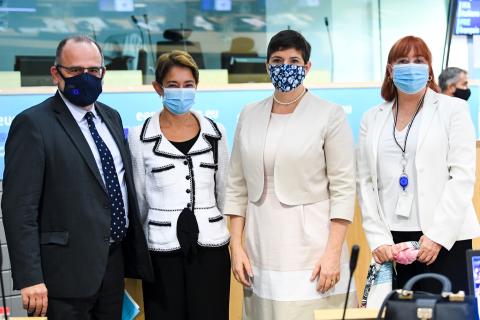
Den 17 september höll Europeiska ekonomiska och sociala kommittén (EESK) en ceremoni i samband med den sista plenarsessionen innan nästa mandatperiod tar vid i oktober. Luca Jahier, EESK:s ordförande sedan april 2018, uttryckte sin tacksamhet till alla ledamöter och underströk hur viktigt bidraget från de civilsamhällesorganisationer som är företrädda i kommittén är för det europeiska projektet.
I sitt sista tal som ordförande lyfte Luca Jahier fram mandatperiodens viktigaste prioriteringar, nämligen hållbar utveckling, stärkta förbindelser mellan EU och Afrika, EU:s utvidgning samt kultur som en enande kraft i Europa. Han framhöll också EESK:s bidrag till de senaste årens arbete med att ta itu med de utmaningar som EU står inför. Kommittén var till exempel den EU-institution som först föreslog en europeisk hälsounion. Han uttryckte sina förhoppningar om att EESK kommer att spela en aktiv roll i konferensen om Europas framtid, som kommissionen och Europaparlamentet föreslagit.
Kommissionens ordförande Ursula von der Leyen skickade ett videomeddelande där hon lovordade EESK:s ”utmärkta arbete” under de senaste fem åren och kommitténs viktiga bidrag till EU:s lagstiftningsförfarande. David Sassoli, Europaparlamentets talman, skickade också ett videomeddelande där han uttryckte sin önskan om ett närmare samarbete med EESK, i syfte att skapa en strukturerad dialog med det organiserade civila samhället. Klara Dobrev, Europaparlamentets vice talman, talade vid kommitténs plenarsession. Hon betonade att ”utan folkets stöd kan vi inte förändra något i världen, och EESK:s roll är att nå ut till det organiserade civila samhället och till människor med olika bakgrund och behov”. (dgf)