European Economic
and Social Committee
European Economic
and Social Committee
The European Economic and Social Committee (EESC) is the voice of organised civil society in Europe.
Find out more about its role and structure at http://www.eesc.europa.eu/en/about
The EESC issues between 160 and 190 opinions, evaluation and information reports a year.
It also organises several annual initiatives and events with a focus on civil society and citizens’ participation such as the Civil Society Prize, the Civil Society Days, the Your Europe, Your Say youth plenary and the ECI Day.
Find the latest EESC opinions and publications at http://www.eesc.europa.eu/en/our-work/opinions-information-reports/opinions and http://www.eesc.europa.eu/en/our-work/publications-other-work/publications respectively.
The EESC is active in a wide range of areas, from social affairs to economy, energy and sustainability.
Learn more about our policy areas and policy highlights at http://www.eesc.europa.eu/en/policies
The EESC holds nine plenary sessions per year. It also organises many conferences, public hearings and high-level debates related to its work.
Find out more about our upcoming events at http://www.eesc.europa.eu/en/agenda/our-events/upcoming-events
Here you can find news and information about the EESC'swork, including its social media accounts, the EESC Info newsletter, photo galleries and videos.
Read the latest EESC news http://www.eesc.europa.eu/en/news-media/news and press releases http://www.eesc.europa.eu/en/news-media/press-releases
The EESC brings together representatives from all areas of organised civil society, who give their independent advice on EU policies and legislation. The EESC's326 Members are organised into three groups: Employers, Workers and Various Interests.
Find out more about our Members and groups at http://www.eesc.europa.eu/en/members-groups
The EESC has six sections, specialising in concrete topics of relevance to the citizens of the European Union, ranging from social to economic affairs, energy, environment, external relations or the internal market.
Find out more at http://www.eesc.europa.eu/en/sections-other-bodies
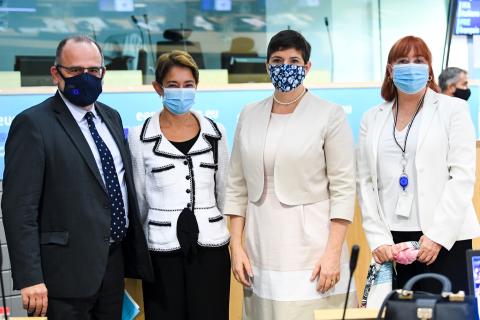
De leden van het Europees Economisch en Sociaal Comité (EESC) hebben op 17 september een afsluitende ceremonie gehouden tijdens hun laatste zitting voor het begin van de nieuwe mandaatsperiode in oktober. Luca Jahier, voorzitter van het EESC sinds april 2018, bedankte alle leden en sprak over de belangrijke bijdrage die de in het EESC vertegenwoordigde maatschappelijke organisaties aan het Europese project hebben geleverd.
Jahier herinnerde in zijn laatste toespraak aan de voornaamste prioriteiten van zijn mandaatsperiode: duurzame ontwikkeling, hechtere betrekkingen tussen de EU en Afrika, de uitbreiding van de EU en cultuur als bindmiddel voor Europa. Ook wees hij erop hoe het EESC zich de afgelopen jaren heeft ingezet om met oplossingen te komen voor de uitdagingen waar de EU voor staat. Zo kwam het EESC als eerste EU-instelling met het idee voor een Europese gezondheidsunie. Tot slot sprak hij de hoop uit dat het EESC een actieve rol krijgt in de conferentie over de toekomst van Europa die de Europese Commissie en het Europees Parlement hebben voorgesteld.
Voorzitter van de Europese Commissie Ursula von der Leyen prees in een videoboodschap het “uitstekende werk” van het EESC in de laatste vijf jaar en zijn belangrijke bijdrage aan de EU-wetgevingsprocedure. Europees Parlementsvoorzitter David Sassoli verklaarde in een videoboodschap bereid te zijn nauwer met het EESC samen te werken om een gestructureerde dialoog met het maatschappelijk middenveld op te zetten. Vicevoorzitter van het Europees Parlement Klara Dobrev benadrukte in een toespraak tijdens de EESC-zitting dat “er niets in de wereld kan veranderen zonder de steun van de burgers en dat het juist de rol van het EESC is om contact te onderhouden met maatschappelijke organisaties, met echte mensen dus met verschillende achtergronden en behoeften”. (dgf)