European Economic
and Social Committee
European Economic
and Social Committee
The European Economic and Social Committee (EESC) is the voice of organised civil society in Europe.
Find out more about its role and structure at http://www.eesc.europa.eu/en/about
The EESC issues between 160 and 190 opinions, evaluation and information reports a year.
It also organises several annual initiatives and events with a focus on civil society and citizens’ participation such as the Civil Society Prize, the Civil Society Days, the Your Europe, Your Say youth plenary and the ECI Day.
Find the latest EESC opinions and publications at http://www.eesc.europa.eu/en/our-work/opinions-information-reports/opinions and http://www.eesc.europa.eu/en/our-work/publications-other-work/publications respectively.
The EESC is active in a wide range of areas, from social affairs to economy, energy and sustainability.
Learn more about our policy areas and policy highlights at http://www.eesc.europa.eu/en/policies
The EESC holds nine plenary sessions per year. It also organises many conferences, public hearings and high-level debates related to its work.
Find out more about our upcoming events at http://www.eesc.europa.eu/en/agenda/our-events/upcoming-events
Here you can find news and information about the EESC'swork, including its social media accounts, the EESC Info newsletter, photo galleries and videos.
Read the latest EESC news http://www.eesc.europa.eu/en/news-media/news and press releases http://www.eesc.europa.eu/en/news-media/press-releases
The EESC brings together representatives from all areas of organised civil society, who give their independent advice on EU policies and legislation. The EESC's326 Members are organised into three groups: Employers, Workers and Various Interests.
Find out more about our Members and groups at http://www.eesc.europa.eu/en/members-groups
The EESC has six sections, specialising in concrete topics of relevance to the citizens of the European Union, ranging from social to economic affairs, energy, environment, external relations or the internal market.
Find out more at http://www.eesc.europa.eu/en/sections-other-bodies
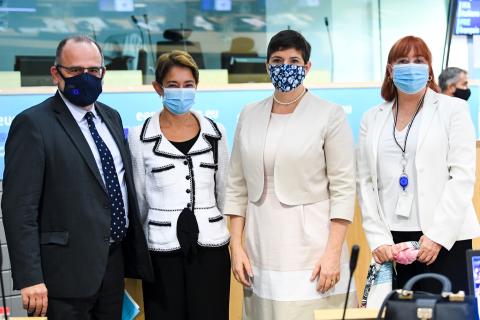
Evropski ekonomsko-socialni odbor (EESO) je 17. septembra na zadnjem plenarnem zasedanju pred začetkom novega mandata v oktobru priredil slovesnost ob koncu sedanjega. Luca Jahier, predsednik EESO od aprila 2018, se je zahvalil vsem članom in poudaril pomemben prispevek organizacij civilne družbe, zastopanih v EESO, k evropskemu projektu.
Luca Jahier je v zadnjem govoru kot predsednik govoril o glavnih prednostnih nalogah svojega mandata, tj. trajnostnem razvoju, okrepljenih odnosih med EU in Afriko, širitvi EU in kulturi kot elementu, ki združuje Evropo. Poudaril je tudi prispevek, ki ga je EESO v zadnjih nekaj letih doprinesel k reševanju izzivov, s katerimi se sooča EU. Bil je na primer prva evropska institucija, ki je predlagala evropsko zdravstveno unijo. Izrazil je upanje, da bo EESO lahko dejavno sodeloval na konferenci o prihodnosti Evrope, ki sta jo predlagala Evropska komisija in Evropski parlament.
Predsednica Evropske komisije Ursula von der Leyen je poslala videosporočilo, v katerem je pohvalila odlično delo, ki ga je EESO opravil v zadnjih petih letih, in njegov pomemben prispevek k zakonodajnemu postopku EU. Predsednik Evropskega parlamenta David Sassoli je v videosporočilu izrazil pripravljenost za tesnejše sodelovanje z EESO pri vzpostavljanju strukturiranega dialoga z organizirano civilno družbo. Podpredsednica Evropskega parlamenta Klara Dobrev je v svojem nagovoru na plenarnem zasedanju EESO poudarila, da „na svetu ni mogoče ničesar spremeniti brez podpore ljudi, prav vloga EESO pa je, da vzpostavi stik z organizirano civilno družbo, z običajnimi ljudmi, ki prihajajo iz različnih okolij in imajo različne potrebe“. (dgf)