European Economic
and Social Committee
European Economic
and Social Committee
The European Economic and Social Committee (EESC) is the voice of organised civil society in Europe.
Find out more about its role and structure at http://www.eesc.europa.eu/en/about
The EESC issues between 160 and 190 opinions, evaluation and information reports a year.
It also organises several annual initiatives and events with a focus on civil society and citizens’ participation such as the Civil Society Prize, the Civil Society Days, the Your Europe, Your Say youth plenary and the ECI Day.
Find the latest EESC opinions and publications at http://www.eesc.europa.eu/en/our-work/opinions-information-reports/opinions and http://www.eesc.europa.eu/en/our-work/publications-other-work/publications respectively.
The EESC is active in a wide range of areas, from social affairs to economy, energy and sustainability.
Learn more about our policy areas and policy highlights at http://www.eesc.europa.eu/en/policies
The EESC holds nine plenary sessions per year. It also organises many conferences, public hearings and high-level debates related to its work.
Find out more about our upcoming events at http://www.eesc.europa.eu/en/agenda/our-events/upcoming-events
Here you can find news and information about the EESC'swork, including its social media accounts, the EESC Info newsletter, photo galleries and videos.
Read the latest EESC news http://www.eesc.europa.eu/en/news-media/news and press releases http://www.eesc.europa.eu/en/news-media/press-releases
The EESC brings together representatives from all areas of organised civil society, who give their independent advice on EU policies and legislation. The EESC's326 Members are organised into three groups: Employers, Workers and Various Interests.
Find out more about our Members and groups at http://www.eesc.europa.eu/en/members-groups
The EESC has six sections, specialising in concrete topics of relevance to the citizens of the European Union, ranging from social to economic affairs, energy, environment, external relations or the internal market.
Find out more at http://www.eesc.europa.eu/en/sections-other-bodies
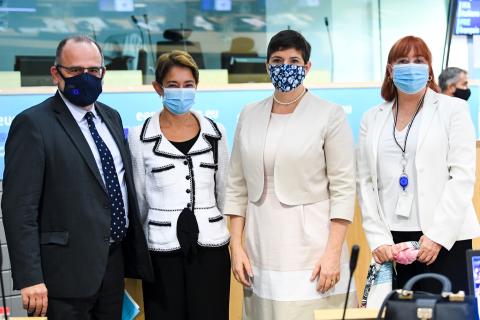
An 17 Meán Fómhair, reáchtáil Coiste Eacnamaíoch agus Sóisialta na hEorpa (CESE) a shearmanas deireadh téarma le linn an tseisiúin iomlánaigh dheireanaigh roimh an gcéad téarma eile i mí Dheireadh Fómhair. Ghabh Luca Jahier, Uachtarán CESE ó mhí Aibreáin 2018 i leith, buíochas leis na comhaltaí go léir agus leag sé béim ar rannchuidiú tábhachtach eagraíochtaí na sochaí sibhialta a ndéantar ionadaíocht orthu ag CESE leis an tionscadal Eorpach.
San óráid deiridh uaidh mar Uachtarán, labhair Luca Jahier faoi phríomhthosaíochtaí a théarma, eadhon, forbairt inbhuanaithe, treisiú chaidreamh AE-na hAfraice, méadú an Aontais Eorpaigh, agus cultúr mar ghné aontach san Eoraip. Leag sé béim freisin ar rannchuidiú CESE le blianta beaga anuas chun dul i ngleic leis na dúshláin atá roimh an Aontas: mar shampla, ba é CESE an chéad institiúid Eorpach a mhol Aontas Eorpach um an tSláinte. Chuir sé in iúl go bhfuil súil aige go bhféadfadh CESE páirt ghníomhach a ghlacadh sa Chomhdháil ar Thodhchaí na hEorpa arna mholadh ag an gCoimisiún Eorpach agus ag Parlaimint na hEorpa.
Sheol Ursula von der Leyen, Uachtarán an Choimisiúin Eorpaigh, teachtaireacht físeáin inar mhol sí an sárobair a rinne CESE le cúig bliana anuas agus a rannchuidiú tábhachtach le nós imeachta reachtach an Aontais. Sheol David Sassoli, Uachtarán Pharlaimint na hEorpa, teachtaireacht fiseáin freisin inar léirigh sé a thoilteanas oibriú níos dlúithe le CESE chun idirphlé struchtúrtha a chruthú leis an tsochaí shibhialta eagraithe. Labhair Klara Dobrev, Leas-Uachtarán Pharlaimint na hEorpa, ag seisiún iomlánach CESE chun a chur i bhfáth “nach féidir aon rud a athrú ar domhan mura bhfuil na daoine taobh thiar dínn, agus gurb é ról CESE dul i dteagmháil leis an tsochaí shibhialta eagraithe, leis na daoine féin, iad uile ó chúlraí éagsúla agus riachtanais éagsúla acu”. (dgf)