European Economic
and Social Committee
European Economic
and Social Committee
The European Economic and Social Committee (EESC) is the voice of organised civil society in Europe.
Find out more about its role and structure at http://www.eesc.europa.eu/en/about
The EESC issues between 160 and 190 opinions, evaluation and information reports a year.
It also organises several annual initiatives and events with a focus on civil society and citizens’ participation such as the Civil Society Prize, the Civil Society Days, the Your Europe, Your Say youth plenary and the ECI Day.
Find the latest EESC opinions and publications at http://www.eesc.europa.eu/en/our-work/opinions-information-reports/opinions and http://www.eesc.europa.eu/en/our-work/publications-other-work/publications respectively.
The EESC is active in a wide range of areas, from social affairs to economy, energy and sustainability.
Learn more about our policy areas and policy highlights at http://www.eesc.europa.eu/en/policies
The EESC holds nine plenary sessions per year. It also organises many conferences, public hearings and high-level debates related to its work.
Find out more about our upcoming events at http://www.eesc.europa.eu/en/agenda/our-events/upcoming-events
Here you can find news and information about the EESC'swork, including its social media accounts, the EESC Info newsletter, photo galleries and videos.
Read the latest EESC news http://www.eesc.europa.eu/en/news-media/news and press releases http://www.eesc.europa.eu/en/news-media/press-releases
The EESC brings together representatives from all areas of organised civil society, who give their independent advice on EU policies and legislation. The EESC's326 Members are organised into three groups: Employers, Workers and Various Interests.
Find out more about our Members and groups at http://www.eesc.europa.eu/en/members-groups
The EESC has six sections, specialising in concrete topics of relevance to the citizens of the European Union, ranging from social to economic affairs, energy, environment, external relations or the internal market.
Find out more at http://www.eesc.europa.eu/en/sections-other-bodies
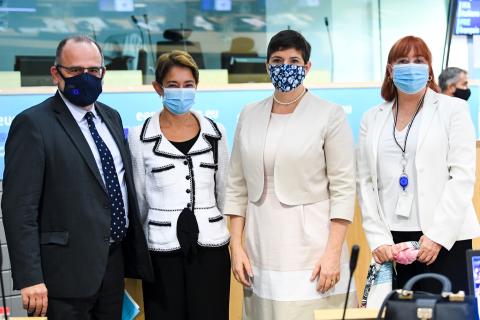
Em 17 de setembro, o Comité Económico e Social Europeu (CESE) realizou a sua cerimónia de fim de mandato por ocasião da última reunião plenária antes do início do próximo mandato, em outubro. Luca Jahier, presidente do CESE desde abril de 2018, expressou a sua gratidão a todos os membros e destacou o importante contributo das organizações da sociedade civil europeia representadas no CESE para o projeto europeu.
No seu último discurso como presidente, Luca Jahier referiu-se às prioridades principais do seu mandato, a saber, o desenvolvimento sustentável, o reforço das relações UE-África, o alargamento da UE e a cultura enquanto fator de coesão da Europa. Realçou igualmente a contribuição do CESE nos últimos anos para superar os desafios que se colocam à UE: por exemplo, foi o CESE a primeira instituição europeia a propor uma União Europeia da Saúde. E fez votos de que o CESE desempenhasse um papel ativo na Conferência sobre o Futuro da Europa, proposta pela Comissão Europeia e pelo Parlamento Europeu.
A presidente da Comissão Europeia, Ursula von der Leyen, enviou uma mensagem de vídeo em que elogiou o «excelente trabalho» realizado pelo CESE nos últimos anos e o seu importante contributo para o processo legislativo da UE. David Sassoli, presidente do Parlamento Europeu, enviou também uma mensagem de vídeo para frisar a sua vontade de colaborar mais estreitamente com o CESE a fim de criar um diálogo estruturado com a sociedade civil organizada. Klara Dobrev, vice-presidente do Parlamento Europeu, interveio na reunião plenária do CESE para realçar que «nada no mundo pode mudar sem o apoio dos cidadãos, e o papel do CESE é assegurar o contacto a com a sociedade civil organizada, com pessoas reais que têm antecedentes e necessidades diferentes». (dgf)