European Economic
and Social Committee
European Economic
and Social Committee
The European Economic and Social Committee (EESC) is the voice of organised civil society in Europe.
Find out more about its role and structure at http://www.eesc.europa.eu/en/about
The EESC issues between 160 and 190 opinions, evaluation and information reports a year.
It also organises several annual initiatives and events with a focus on civil society and citizens’ participation such as the Civil Society Prize, the Civil Society Days, the Your Europe, Your Say youth plenary and the ECI Day.
Find the latest EESC opinions and publications at http://www.eesc.europa.eu/en/our-work/opinions-information-reports/opinions and http://www.eesc.europa.eu/en/our-work/publications-other-work/publications respectively.
The EESC is active in a wide range of areas, from social affairs to economy, energy and sustainability.
Learn more about our policy areas and policy highlights at http://www.eesc.europa.eu/en/policies
The EESC holds nine plenary sessions per year. It also organises many conferences, public hearings and high-level debates related to its work.
Find out more about our upcoming events at http://www.eesc.europa.eu/en/agenda/our-events/upcoming-events
Here you can find news and information about the EESC'swork, including its social media accounts, the EESC Info newsletter, photo galleries and videos.
Read the latest EESC news http://www.eesc.europa.eu/en/news-media/news and press releases http://www.eesc.europa.eu/en/news-media/press-releases
The EESC brings together representatives from all areas of organised civil society, who give their independent advice on EU policies and legislation. The EESC's326 Members are organised into three groups: Employers, Workers and Various Interests.
Find out more about our Members and groups at http://www.eesc.europa.eu/en/members-groups
The EESC has six sections, specialising in concrete topics of relevance to the citizens of the European Union, ranging from social to economic affairs, energy, environment, external relations or the internal market.
Find out more at http://www.eesc.europa.eu/en/sections-other-bodies
Il 17 settembre, durante l'ultima sessione plenaria prima dell'inizio del prossimo mandato in ottobre, il Comitato economico e sociale europeo (CESE) ha tenuto la sua cerimonia di fine mandato. Luca Jahier, Presidente del CESE dall'aprile 2018, ha espresso la sua gratitudine a tutti i membri e sottolineato l'importante contributo che le organizzazioni della società civile rappresentate al CESE apportano al progetto europeo.
Nel suo ultimo discorso come Presidente del CESE, Jahier ha parlato delle principali priorità del suo mandato, vale a dire lo sviluppo sostenibile, il rafforzamento delle relazioni UE-Africa, l'allargamento dell'UE e la cultura come elemento unificante in Europa. Ha inoltre messo in evidenza il contributo fornito dal CESE negli ultimi anni nell'affrontare le sfide che l'UE si trova dinanzi, ricordando che, per esempio, il CESE è stata la prima istituzione europea a proporre un'Unione sanitaria europea, e auspicando una partecipazione attiva del CESE alla conferenza sul futuro dell'Europa proposta dalla Commissione europea e dal Parlamento europeo.
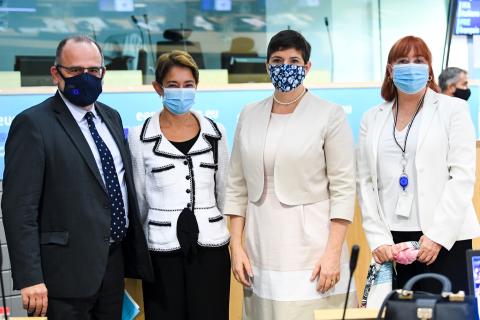
La Presidente della Commissione europea Ursula von der Leyen ha inviato un video in cui elogia l'"eccellente lavoro" svolto dal CESE negli ultimi cinque anni e il suo importante contributo alla procedura legislativa dell'UE. Anche il Presidente del Parlamento europeo David Sassoli ha inviato un videomessaggio in cui esprime la sua volontà di collaborare in maniera più ravvicinata con il CESE per creare un dialogo strutturato con la società civile. Klara Dobrev, Vicepresidente del Parlamento europeo, ha preso la parola alla plenaria del CESE per sottolineare che "nulla può cambiare nel mondo se non abbiamo il sostegno della gente; il ruolo del CESE è appunto quello di entrare in contatto con la società civile organizzata, con persone reali, provenienti da differenti contesti e con bisogni diversi" (dgf)