European Economic
and Social Committee
European Economic
and Social Committee
The European Economic and Social Committee (EESC) is the voice of organised civil society in Europe.
Find out more about its role and structure at http://www.eesc.europa.eu/en/about
The EESC issues between 160 and 190 opinions, evaluation and information reports a year.
It also organises several annual initiatives and events with a focus on civil society and citizens’ participation such as the Civil Society Prize, the Civil Society Days, the Your Europe, Your Say youth plenary and the ECI Day.
Find the latest EESC opinions and publications at http://www.eesc.europa.eu/en/our-work/opinions-information-reports/opinions and http://www.eesc.europa.eu/en/our-work/publications-other-work/publications respectively.
The EESC is active in a wide range of areas, from social affairs to economy, energy and sustainability.
Learn more about our policy areas and policy highlights at http://www.eesc.europa.eu/en/policies
The EESC holds nine plenary sessions per year. It also organises many conferences, public hearings and high-level debates related to its work.
Find out more about our upcoming events at http://www.eesc.europa.eu/en/agenda/our-events/upcoming-events
Here you can find news and information about the EESC'swork, including its social media accounts, the EESC Info newsletter, photo galleries and videos.
Read the latest EESC news http://www.eesc.europa.eu/en/news-media/news and press releases http://www.eesc.europa.eu/en/news-media/press-releases
The EESC brings together representatives from all areas of organised civil society, who give their independent advice on EU policies and legislation. The EESC's326 Members are organised into three groups: Employers, Workers and Various Interests.
Find out more about our Members and groups at http://www.eesc.europa.eu/en/members-groups
The EESC has six sections, specialising in concrete topics of relevance to the citizens of the European Union, ranging from social to economic affairs, energy, environment, external relations or the internal market.
Find out more at http://www.eesc.europa.eu/en/sections-other-bodies
Konkurrenskraft, små och medelstora företag och social delaktighet är centrala inslag i det belgiska ordförandeskapets program. Europeiska ekonomiska och sociala kommittén (EESK) lägger fram politiska rekommendationer om förhållandet mellan ekonomisk styrning, långsiktig tillväxt för alla och hållbar säkerhet samt om den sociala ekonomins kraft när det handlar om att bekämpa fattigdom och social utestängning.
Under första halvåret 2024 innehar Belgien för trettonde gången ordförandeskapet för Europeiska unionens råd. Ordförandeskapets prioriteringar diskuterades under två debatter i samband med EESK:s plenarsession i januari.
EESK:s ordförande Oliver Röpke lovordade ordförandeskapet för att det inkluderar arbetsmarknadens parter i sitt arbete. Belgiens ordförandeskap äger rum i slutet av EU:s institutionella cykel, vilket innebär att landet måste hantera lagstiftningskompromisser och vägleda Europeiska rådet inför och under valet till Europaparlamentet.
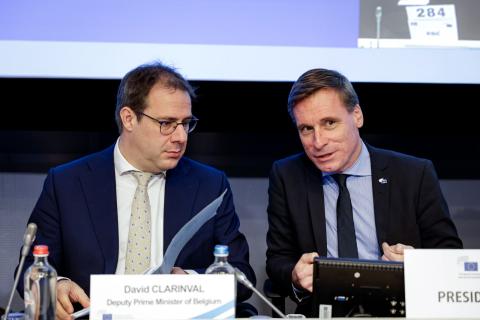
Belgiens vice premiärminister, David Clarinval, redogjorde för ordförandeskapets synpunkter på reformen av den gemensamma jordbrukspolitiken, skyddet för egenföretagare och EU:s industripolitik. Genom att begära 13 rådgivande yttranden från EESK strävar ordförandeskapet efter att bidra till diskussionerna om den strategiska agendan för 2024–2029. En interinstitutionell förklaring i april kommer att vara inriktad på EU:s framtida sociala agenda. Ordförandeskapets prioriteringar omfattar bland annat en grön och social omställning samt åtgärder mot klimatkrisen och krisen för den biologiska mångfalden. Dess betoning på rättvis arbetskraftsrörlighet och ett hållbart socialt skydd är en central fråga i EESK:s dialog med arbetsmarknadens parter. Att stärka den europeiska konkurrenskraften, stödja små och medelstora företag och främja en balanserad handelspolitik för Europa i världen kommer att vara centrala fokusområden. (tk)