European Economic
and Social Committee
European Economic
and Social Committee
The European Economic and Social Committee (EESC) is the voice of organised civil society in Europe.
Find out more about its role and structure at http://www.eesc.europa.eu/en/about
The EESC issues between 160 and 190 opinions, evaluation and information reports a year.
It also organises several annual initiatives and events with a focus on civil society and citizens’ participation such as the Civil Society Prize, the Civil Society Days, the Your Europe, Your Say youth plenary and the ECI Day.
Find the latest EESC opinions and publications at http://www.eesc.europa.eu/en/our-work/opinions-information-reports/opinions and http://www.eesc.europa.eu/en/our-work/publications-other-work/publications respectively.
The EESC is active in a wide range of areas, from social affairs to economy, energy and sustainability.
Learn more about our policy areas and policy highlights at http://www.eesc.europa.eu/en/policies
The EESC holds nine plenary sessions per year. It also organises many conferences, public hearings and high-level debates related to its work.
Find out more about our upcoming events at http://www.eesc.europa.eu/en/agenda/our-events/upcoming-events
Here you can find news and information about the EESC'swork, including its social media accounts, the EESC Info newsletter, photo galleries and videos.
Read the latest EESC news http://www.eesc.europa.eu/en/news-media/news and press releases http://www.eesc.europa.eu/en/news-media/press-releases
The EESC brings together representatives from all areas of organised civil society, who give their independent advice on EU policies and legislation. The EESC's326 Members are organised into three groups: Employers, Workers and Various Interests.
Find out more about our Members and groups at http://www.eesc.europa.eu/en/members-groups
The EESC has six sections, specialising in concrete topics of relevance to the citizens of the European Union, ranging from social to economic affairs, energy, environment, external relations or the internal market.
Find out more at http://www.eesc.europa.eu/en/sections-other-bodies
La competitividad, las pymes y la inclusión social ocupan un lugar central en el programa de la Presidencia belga. El Comité Económico y Social Europeo (CESE) formula recomendaciones políticas sobre la relación entre gobernanza económica, crecimiento integrador a largo plazo y seguridad sostenible y sobre el poder de la economía social en la lucha contra la pobreza y la exclusión social.
En el primer semestre de 2024, Bélgica ejerce su decimotercera Presidencia del Consejo de la Unión Europea, cuyas prioridades se trataron en dos debates organizados por el CESE en su pleno de enero.
El presidente del CESE, Oliver Röpke, elogió a la Presidencia por incluir a los interlocutores sociales en sus trabajos. La Presidencia belga concluye el ciclo institucional de la UE, lo que obliga al país a gestionar los compromisos legislativos y guiar al Consejo de la UE durante la campaña y las elecciones al Parlamento Europeo.
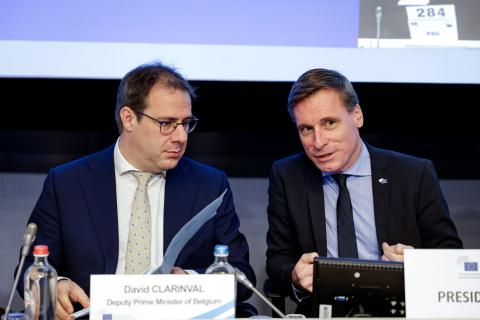
El vice primer ministro belga, David Clarinval, expuso los puntos de vista de la Presidencia sobre la reforma de la política agrícola común, la protección de los trabajadores autónomos y la política industrial de la UE. La Presidencia ha solicitado al CESE elaborar trece dictámenes consultivos, con los que se propone contribuir a los debates sobre la Agenda Estratégica 2024-2029. En abril se publicará una declaración interinstitucional que se centrará en la futura agenda social de la UE. Entre las prioridades de la Presidencia figura una doble transición ecológica y social que afronte la crisis climática y la pérdida de biodiversidad. Su énfasis en la movilidad laboral justa y la protección social sostenible constituye el núcleo del diálogo de los interlocutores sociales del CESE. Reforzar la competitividad europea, apoyar a las pymes y promover una política comercial equilibrada para una Europa global serán ámbitos de interés fundamental. (tk)