European Economic
and Social Committee
European Economic
and Social Committee
The European Economic and Social Committee (EESC) is the voice of organised civil society in Europe.
Find out more about its role and structure at http://www.eesc.europa.eu/en/about
The EESC issues between 160 and 190 opinions, evaluation and information reports a year.
It also organises several annual initiatives and events with a focus on civil society and citizens’ participation such as the Civil Society Prize, the Civil Society Days, the Your Europe, Your Say youth plenary and the ECI Day.
Find the latest EESC opinions and publications at http://www.eesc.europa.eu/en/our-work/opinions-information-reports/opinions and http://www.eesc.europa.eu/en/our-work/publications-other-work/publications respectively.
The EESC is active in a wide range of areas, from social affairs to economy, energy and sustainability.
Learn more about our policy areas and policy highlights at http://www.eesc.europa.eu/en/policies
The EESC holds nine plenary sessions per year. It also organises many conferences, public hearings and high-level debates related to its work.
Find out more about our upcoming events at http://www.eesc.europa.eu/en/agenda/our-events/upcoming-events
Here you can find news and information about the EESC'swork, including its social media accounts, the EESC Info newsletter, photo galleries and videos.
Read the latest EESC news http://www.eesc.europa.eu/en/news-media/news and press releases http://www.eesc.europa.eu/en/news-media/press-releases
The EESC brings together representatives from all areas of organised civil society, who give their independent advice on EU policies and legislation. The EESC's326 Members are organised into three groups: Employers, Workers and Various Interests.
Find out more about our Members and groups at http://www.eesc.europa.eu/en/members-groups
The EESC has six sections, specialising in concrete topics of relevance to the citizens of the European Union, ranging from social to economic affairs, energy, environment, external relations or the internal market.
Find out more at http://www.eesc.europa.eu/en/sections-other-bodies
Competitiveness, SMEs and social inclusion are at the heart of the Belgian Presidency programme. The European Economic and Social Committee (EESC) makes policy recommendations on the relationship between economic governance, long-term inclusive growth and sustainable security, as well as on the power of social economy in combating poverty and social exclusion.
In the first half of 2024, Belgium holds its thirteenth Presidency of the Council of the European Union, the priorities of which were discussed during two debates organised by the EESC at its plenary session in January.
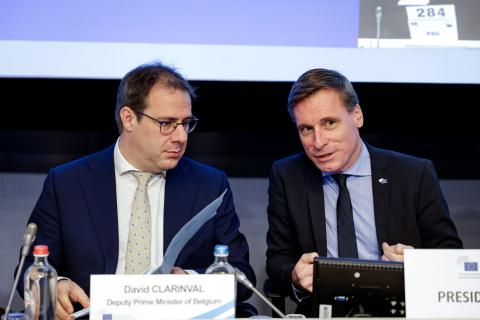
EESC President Oliver Röpke commended the Presidency for including social partners in its work. Belgium's Presidency concludes the EU's institutional cycle, requiring the country to handle legislative compromises and guide the EU Council during the European Parliament campaign and elections.
Belgian Deputy Prime Minister David Clarinval outlined the Presidency's views on common agricultural policy reform, protection for self-employed people, and EU industrial policy. In requesting 13 advisory opinions from the EESC, the Presidency aims to contribute to discussions on the 2024-29 Strategic Agenda. An interinstitutional declaration in April will focus on the future social agenda of the EU. The Presidency's priorities include a green and social transition, addressing climate and biodiversity crises. Its emphasis on fair labour mobility and sustainable social protection is at the heart of the EESC social partners' dialogue. Strengthening European competitiveness, supporting SMEs and promoting a balanced trade policy for Global Europe will be key focus areas. (tk)