European Economic
and Social Committee
European Economic
and Social Committee
The European Economic and Social Committee (EESC) is the voice of organised civil society in Europe.
Find out more about its role and structure at http://www.eesc.europa.eu/en/about
The EESC issues between 160 and 190 opinions, evaluation and information reports a year.
It also organises several annual initiatives and events with a focus on civil society and citizens’ participation such as the Civil Society Prize, the Civil Society Days, the Your Europe, Your Say youth plenary and the ECI Day.
Find the latest EESC opinions and publications at http://www.eesc.europa.eu/en/our-work/opinions-information-reports/opinions and http://www.eesc.europa.eu/en/our-work/publications-other-work/publications respectively.
The EESC is active in a wide range of areas, from social affairs to economy, energy and sustainability.
Learn more about our policy areas and policy highlights at http://www.eesc.europa.eu/en/policies
The EESC holds nine plenary sessions per year. It also organises many conferences, public hearings and high-level debates related to its work.
Find out more about our upcoming events at http://www.eesc.europa.eu/en/agenda/our-events/upcoming-events
Here you can find news and information about the EESC'swork, including its social media accounts, the EESC Info newsletter, photo galleries and videos.
Read the latest EESC news http://www.eesc.europa.eu/en/news-media/news and press releases http://www.eesc.europa.eu/en/news-media/press-releases
The EESC brings together representatives from all areas of organised civil society, who give their independent advice on EU policies and legislation. The EESC's326 Members are organised into three groups: Employers, Workers and Various Interests.
Find out more about our Members and groups at http://www.eesc.europa.eu/en/members-groups
The EESC has six sections, specialising in concrete topics of relevance to the citizens of the European Union, ranging from social to economic affairs, energy, environment, external relations or the internal market.
Find out more at http://www.eesc.europa.eu/en/sections-other-bodies
A competitividade, as PME e a inclusão social estão no cerne do programa da Presidência belga. O Comité Económico e Social Europeu (CESE) formula recomendações políticas sobre a relação entre a governação económica, o crescimento inclusivo a longo prazo e a segurança sustentável, bem como sobre o poder da economia social na luta contra a pobreza e a exclusão social.
No primeiro semestre de 2024, a Bélgica exerce a sua décima terceira Presidência do Conselho da União Europeia, cujas prioridades foram objeto de dois debates organizados pelo CESE na sua reunião plenária de janeiro.
O presidente do CESE, Oliver Röpke, louvou a Presidência por ter incluído os parceiros sociais nos seus trabalhos. A Presidência belga conclui o ciclo institucional da UE, o que obriga o país a gerir os compromissos legislativos e a orientar o Conselho da UE durante a campanha eleitoral e as eleições para o Parlamento Europeu.
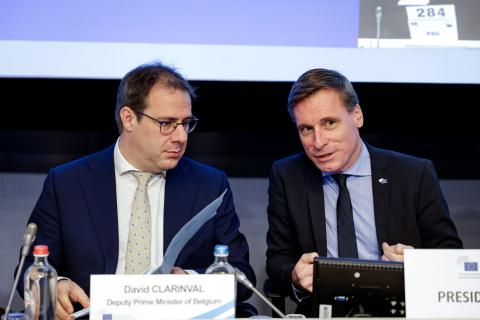
David Clarinval, vice-primeiro-ministro belga, apresentou os pontos de vista da Presidência sobre a reforma da política agrícola comum, a proteção dos trabalhadores independentes e a política industrial da UE. A Presidência solicitou ao CESE a elaboração de treze pareceres exploratórios, com os quais pretende contribuir para os debates sobre a Agenda Estratégica da UE para 2024-2029. Em abril será publicada uma declaração interinstitucional que se centrará na futura agenda social da UE. As prioridades da Presidência incluem a transição ecológica e social para fazer face à crise climática e à perda de biodiversidade. A sua ênfase na mobilidade laboral justa e na proteção social sustentável está no cerne do diálogo dos parceiros sociais do CESE. O reforço da competitividade europeia, o apoio às PME e a promoção de uma política comercial equilibrada para a Europa Global serão domínios de interesse prioritários. (tk)