European Economic
and Social Committee
European Economic
and Social Committee
The European Economic and Social Committee (EESC) is the voice of organised civil society in Europe.
Find out more about its role and structure at http://www.eesc.europa.eu/en/about
The EESC issues between 160 and 190 opinions, evaluation and information reports a year.
It also organises several annual initiatives and events with a focus on civil society and citizens’ participation such as the Civil Society Prize, the Civil Society Days, the Your Europe, Your Say youth plenary and the ECI Day.
Find the latest EESC opinions and publications at http://www.eesc.europa.eu/en/our-work/opinions-information-reports/opinions and http://www.eesc.europa.eu/en/our-work/publications-other-work/publications respectively.
The EESC is active in a wide range of areas, from social affairs to economy, energy and sustainability.
Learn more about our policy areas and policy highlights at http://www.eesc.europa.eu/en/policies
The EESC holds nine plenary sessions per year. It also organises many conferences, public hearings and high-level debates related to its work.
Find out more about our upcoming events at http://www.eesc.europa.eu/en/agenda/our-events/upcoming-events
Here you can find news and information about the EESC'swork, including its social media accounts, the EESC Info newsletter, photo galleries and videos.
Read the latest EESC news http://www.eesc.europa.eu/en/news-media/news and press releases http://www.eesc.europa.eu/en/news-media/press-releases
The EESC brings together representatives from all areas of organised civil society, who give their independent advice on EU policies and legislation. The EESC's326 Members are organised into three groups: Employers, Workers and Various Interests.
Find out more about our Members and groups at http://www.eesc.europa.eu/en/members-groups
The EESC has six sections, specialising in concrete topics of relevance to the citizens of the European Union, ranging from social to economic affairs, energy, environment, external relations or the internal market.
Find out more at http://www.eesc.europa.eu/en/sections-other-bodies
A belga elnökség programjának középpontjában a versenyképesség, a kkv-k és a társadalmi befogadás áll. Az Európai Gazdasági és Szociális Bizottság (EGSZB) szakpolitikai ajánlásokat fogalmaz meg a gazdasági kormányzás, a hosszú távú inkluzív növekedés és a fenntartható biztonság közötti kapcsolatról, valamint a szociális gazdaságnak a szegénység és a társadalmi kirekesztés elleni küzdelemben betöltött szerepéről.
2024 első felében Belgium 13. alkalommal tölti be az Európai Unió Tanácsának elnökségét, amelynek prioritásait az EGSZB januári plenáris ülésszakán két vita keretében vitatták meg.
Oliver Röpke, az EGSZB elnöke méltatta az elnökséget, amiért munkájába bevonja a szociális partnereket. A jelenlegi uniós intézményi ciklus végéhez közeledve a belga elnökség feladata számos jogalkotási kompromisszum kezelése, valamint az EU Tanácsának irányítása az európai parlamenti választási kampány és a választások során.
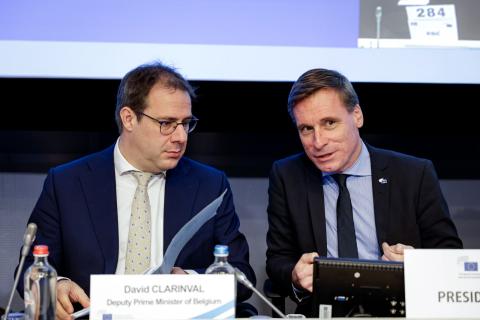
David Clarinval belga miniszterelnök-helyettes ismertette az elnökség álláspontját a közös agrárpolitika reformjáról, az önálló vállalkozók védelméről és az EU iparpolitikájáról. 13 konzultatív véleményt kérve az EGSZB-től az elnökség célja, hogy hozzájáruljon a 2024–2029-es stratégiai menetrendről folytatott megbeszélésekhez. Áprilisban elfogadnak majd egy intézményközi nyilatkozatot, amelynek középpontjában az EU jövőbeli szociális menetrendje áll. Az elnökség prioritásai között szerepel a zöld és társadalmi átalakulás, valamint az éghajlati és a biológiai sokféleséggel kapcsolatos válság kezelése. Az EGSZB szociális partnerei közötti párbeszéd középpontjában a tisztességes munkaerő-mobilitás és a fenntartható szociális védelem áll. További kiemelt téma lesz az európai versenyképesség megerősítése, a kkv-k támogatása és kiegyensúlyozott kereskedelempolitika előmozdítása a Globális Európa számára. (tk)