European Economic
and Social Committee
European Economic
and Social Committee
The European Economic and Social Committee (EESC) is the voice of organised civil society in Europe.
Find out more about its role and structure at http://www.eesc.europa.eu/en/about
The EESC issues between 160 and 190 opinions, evaluation and information reports a year.
It also organises several annual initiatives and events with a focus on civil society and citizens’ participation such as the Civil Society Prize, the Civil Society Days, the Your Europe, Your Say youth plenary and the ECI Day.
Find the latest EESC opinions and publications at http://www.eesc.europa.eu/en/our-work/opinions-information-reports/opinions and http://www.eesc.europa.eu/en/our-work/publications-other-work/publications respectively.
The EESC is active in a wide range of areas, from social affairs to economy, energy and sustainability.
Learn more about our policy areas and policy highlights at http://www.eesc.europa.eu/en/policies
The EESC holds nine plenary sessions per year. It also organises many conferences, public hearings and high-level debates related to its work.
Find out more about our upcoming events at http://www.eesc.europa.eu/en/agenda/our-events/upcoming-events
Here you can find news and information about the EESC'swork, including its social media accounts, the EESC Info newsletter, photo galleries and videos.
Read the latest EESC news http://www.eesc.europa.eu/en/news-media/news and press releases http://www.eesc.europa.eu/en/news-media/press-releases
The EESC brings together representatives from all areas of organised civil society, who give their independent advice on EU policies and legislation. The EESC's326 Members are organised into three groups: Employers, Workers and Various Interests.
Find out more about our Members and groups at http://www.eesc.europa.eu/en/members-groups
The EESC has six sections, specialising in concrete topics of relevance to the citizens of the European Union, ranging from social to economic affairs, energy, environment, external relations or the internal market.
Find out more at http://www.eesc.europa.eu/en/sections-other-bodies
Konkurrenceevne, SMV'er og social inklusion er kernen i det belgiske EU-formandskabs program. Det Europæiske Økonomiske og Sociale Udvalg (EØSU) fremsætter politiske anbefalinger om forholdet mellem økonomisk styring, langsigtet inklusiv vækst og bæredygtig sikkerhed samt om socialøkonomiens evne til at bekæmpe fattigdom og social udstødelse.
I første halvdel af 2024 varetager Belgien sit trettende formandskab for Rådet for Den Europæiske Union, og formandskabets prioriteter blev drøftet under to debatter tilrettelagt af EØSU på plenarforsamlingen i januar.
EØSU's formand, Oliver Röpke, roste formandskabet for at inddrage arbejdsmarkedets parter i sit arbejde. Belgiens formandskab afslutter EU's institutionelle cyklus, hvilket betyder, at landet skal håndtere lovgivningsmæssige kompromiser og lede Rådet under valgkampagnerne og valget til Europa-Parlamentet.
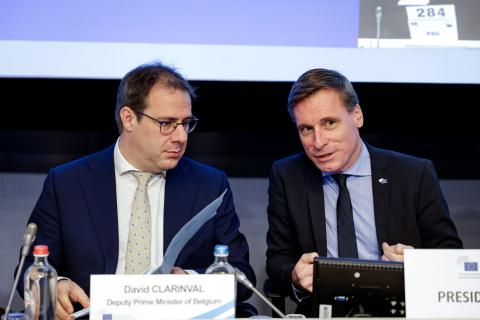
Belgiens vicepremierminister, David Clarinval, redegjorde for formandskabets holdninger til reformen af den fælles landbrugspolitik, beskyttelsen af selvstændige arbejdstagere og EU's industripolitik. Formandskabet har anmodet EØSU om 13 rådgivende udtalelser og sigter dermed mod at bidrage til debatten om den strategiske dagsorden for 2024-2029. En interinstitutionel erklæring i april vil sætte fokus på EU's fremtidige sociale dagsorden. Formandskabets prioriteter omfatter en grøn og en social omstilling og håndtering af klima- og biodiversitetskriserne. Dets fokus på fair mobilitet for arbejdstagere og bæredygtig social beskyttelse er også kernen i EØSU's dialog med arbejdsmarkedets parter. Styrkelse af den europæiske konkurrenceevne, støtte til SMV'er og fremme af en afbalanceret handelspolitik for et globalt Europa vil være centrale fokusområder. (tk)