Europe's care sector will be barely capable of responding to the growing care demands of its ageing population. It is in dire need of major investments and a shift in policy-making, which should ensure that care workers are properly paid, have regulated working hours and receive adequate support. To achieve this, EU action will not be enough, and political will at national level will be crucial, an EESC hearing said.
The EESC firmly believes that a care model for dependent older people with long-term care needs should be mainstreamed into EU policymaking, given that the proportion of the population aged over 80 is expected to more than double by 2050. The pandemic revealed failures and shortcomings in this area, which must be addressed fast. The Commission's initiative to establish a new European Care Strategy is a step in this direction, but consultative institutions and European civil society organisations representing older people have to have a say.
This public hearing will aim to present and discuss the European Commission’s Strategy on Intergenerational Fariness, a new strategic framework to guarantee that current decisions are made with the future in mind, ensuring a fair balance of benefits and burdens across all generations. The event will gather key institutional actors, civil society organisations, social partners and experts to reflect on the Strategy's priorities and to contribute to the preparation of the EESC Opinion (SOC/868).
The event will be webstreamed (EN, original). No registration is needed and participation is free of charge.
Follow us on X: @EESC_SOC
Ask your questions to the panelists via Sli.do with the event code: #IntergenStrategy
"Cohesion policy 2028–2034: A new fund, a new framework, a new role for civil society?" brings together EU institutions, social partners and civil society representatives to reflect on the future of cohesion policy in the next Multiannual Financial Framework. The hearing explores proposals for reforming cohesion funding and governance, assesses the implications of the new framework through the National and Regional Partnership Plans and examines how civil society organisations can play a stronger role in the design, implementation and monitoring of cohesion policy. The discussion aims to identify how cohesion policy can continue to deliver territorial, social and economic cohesion while responding to new challenges and transitions facing the European Union.
The public hearing will examine how national, local and civil society actors will work together to foster collaboration through partnership principle and multi-level governance in order to deliver more inclusive, sustainable, and resilient outcomes across all regions.
Interactio and Room VMA 23, EESC building, Rue Van Maerlant 2, 1040 Brussels
Brussels
Belgium
The EESC is organising a hybrid public hearing on 28 May 2024 from 9:30 am to 1 pm.
Its objective is to hear from policy makers, civil society organisations and social partners, about the importance of affordable community -based services and of a human rights approach to mental health care
The outcomes of the hearing will feed into the EESC's opinion "Mental Health Community Services"
Interactio and Room JDE 60, EESC building, Rue Belliard 99, 1040
Brussels
Belgium
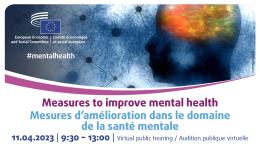
In order to prepare the exploratory opinion requested by the future Spanish presidency of the EU on "Measures to improve mental health", the EESC is organising a hybrid public hearing on 11 April 2023 from 9:30 am to 1 pm.
The aim of the event is to gather input from policy makers, civil society organisations and social partners, which will feed into the EESC's opinion.
the explosion of the phenomenon during the pandemic
Location
Interactio and Room JDE 60, EESC building, Rue Belliard 99, 1040
Brussels
Belgium
In order to prepare its own initiative opinion on "The role of family members caring for people with disabilities and the elderly: the explosion of the phenomenon during the pandemic", the EESC is organising a remote public hearing on 4 July 2022 from 9:30 am to 1 pm.
The aim of the event is to gather input from policy makers, civil society organisations and social partners, which will feed into the EESC's opinion.
Interactio and Room VMA3, VMA building, Rue Van Maerlant 1, 1040
Brussels
Belgium
In order to prepare its own-initiative opinion, the EESC is organising a remote public hearing on "Towards a new care model for the elderly: learning from the Covid-19 pandemic" on 27 October 2021.
The aim of the event is to gather input from other EU Institutions and civil society organisations.
We will debate around the following questions:
Which are the structural causes that have led to the elderly care systems to become some of the most contagious and lethal factors of this pandemic?
What are the strengths and weaknesses of the various care models in the EU?
Which are the civil society perspective and proposals for a new care model for the elderly?