
European Economic
and Social Committee
EESC PLENARY: Interview with rapporteur Ionuţ Sibian on the proposed AgoraEU and Justice programmes
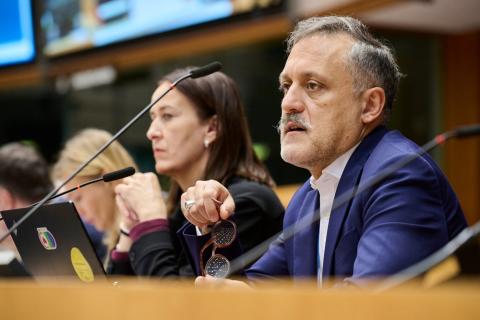
We spoke with Ionuţ Sibian, the rapporteur for the EESC opinion SOC/843 on 'AgoraEU and Justice programmes: strengthening democracy and justice in Europe'.
Watch his video statement on the opinion and read the interview below:
What are the three main findings of this opinion?
First, the opinion confirms that the proposed AgoraEU and Justice programmes are central tools for delivering the EU’s ‘Free and Democratic Europe’ priority, but it also underlines that funding for democracy, rights and civil society still remains modest compared to other EU policies.
Second, EESC members find that the proposals do not yet fully recognise the advocacy role of civil society, nor do they provide sufficiently stable funding for organisations that protect EU values or for those working on victims’ rights and access to justice.
Third, the opinion highlights persistent structural problems: geographical funding imbalances – especially an east–west divide – unclear synergies between EU programmes and the absence of formal structured civil dialogue in the new AgoraEU proposal.
What are the main recommendations or proposals of the opinion?
The EESC recommends that the AgoraEU regulation explicitly recognises advocacy as a core function of civil society organisations, and that it introduces operating grants across all three parts of the AgoraEU programme (culture, media and EU values), as well as for non-profit networks, under the Justice Programme. This is essential to ensure their long-term resilience.
The opinion calls for clear co-financing rules and the possibility of up to 100% EU funding where national or private co-funding is not realistic, particularly for smaller and grassroots organisations. It supports financial support to third parties, but insists that intermediaries must be fully independent and comply with the Charter of Fundamental Rights.
We also propose a stronger, explicit focus on victims’ rights and access to justice, measures to correct east–west funding imbalances, a concrete plan for combined funding between AgoraEU and the Justice Programme, and the reintroduction of a legal basis for structured civil dialogue in the new AgoraEU programme.
After the adoption of this opinion, what have you done/will you do to promote it?
I am presenting the opinion’s key messages to the European Parliament rapporteurs and shadow rapporteurs on the AgoraEU and Justice files, as well as to the relevant Commission services. I will also discuss it with Member States’ representatives and civil society organisations platforms in Brussels such Civil Society Europe and in particular in central and eastern Europe, where funding imbalances are most acute.
At national level, I plan to use media interviews, public debates and meetings with NGOs and professional networks to explain why the recognition of civil society's advocacy function, access to justice and balanced funding across Member States must remain priorities in the final negotiations.
The EESC opinion on 'AgoraEU and Justice programmes: strengthening democracy and justice in Europe' was presented and adopted at the EESC plenary session in December 2025. Read it at: https://link.europa.eu/r7h84n
Ionut SIBIAN (Romania)
Member, EESC Civil Society Organisations' Group
Executive Director, Civil Society Development Foundation (FDSC)
Member of the Board of Directors, Orange Foundation