
European Economic
and Social Committee
De EU-instellingen moeten dringend een gestructureerde burgerdialoog voeren conform artikel 11 van het EU-Verdrag
Door de EESC-groep Maatschappelijke Organisaties
Europese maatschappelijke organisaties hebben op 24 januari een open brief gestuurd aan de voorzitters van de Europese Commissie en het Europees Parlement en aan het Belgische voorzitterschap van de Raad van de Europese Unie. De ondertekenaars van de brief verzoeken de drie belangrijkste instellingen van de Europese Unie (EU) die betrokken zijn bij de Europese besluitvorming met klem concrete maatregelen te nemen om op alle beleidsterreinen een open, transparante en regelmatige dialoog met het maatschappelijk middenveld op gang te brengen, conform artikel 11 van het Verdrag betreffende de Europese Unie.
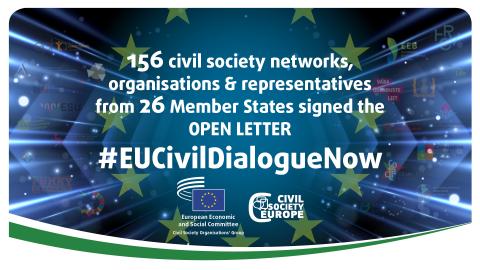
De open brief was een initiatief van de groep Maatschappelijke Organisaties van het EESC en Civil Society Europe, en bevat een aantal concrete voorstellen. In totaal sloten 156 ondertekenaars uit 26 lidstaten zich aan bij de brief, namelijk 39 Europese netwerken, 85 nationale organisaties en 60 leden van de groep Maatschappelijke Organisaties van het EESC.
De wettelijke bepalingen ten spijt blijft de burgerdialoog in de EU-instellingen fragmentarisch en ongestructureerd. De ondertekenaars van de open brief #EUCivilDialogueNow roepen de EU-instellingen dan ook op om:
- het initiatief te nemen tot een interinstitutionele overeenkomst over de burgerdialoog;
- binnen elke instelling posten te creëren voor leidinggevenden die belast worden met de betrekkingen met het maatschappelijk middenveld;
- de samenwerking tussen civiele en sociale actoren aan te moedigen en te bevorderen.
Deze inspanningen moeten voortbouwen op de aanbevelingen van de Conferentie over de toekomst van Europa. Als eerste stap stellen de ondertekenaars voor dat de Europese Commissie een mededeling uitbrengt over de versterking van de burgerdialoog op EU-niveau.
De open brief is in 24 talen beschikbaar op: https://www.eesc.europa.eu/nl/agenda/our-events/events/eu-civil-dialogue-now/open-letter.
Meer informatie is te vinden in het persbericht waarin de open brief wordt aangekondigd, dat in 24 talen beschikbaar is op: https://www.eesc.europa.eu/nl/agenda/our-events/events/eu-civil-dialogue-now.