
European Economic
and Social Committee
Instituições da UE devem aplicar urgentemente um diálogo civil estruturado, em cumprimento do artigo 11.º do Tratado da UE
Pelo Grupo das Organizações da Sociedade Civil do CESE
Em 24 de janeiro, a sociedade civil europeia enviou uma carta aberta aos presidentes da Comissão Europeia e do Parlamento Europeu, bem como à Presidência belga do Conselho da União Europeia. Os signatários da carta instaram as três principais instituições da União Europeia (UE) envolvidas no processo de decisão da UE a adotarem medidas concretas para aplicar um diálogo aberto, transparente e regular com as organizações da sociedade civil em todos os domínios de intervenção, como previsto no artigo 11.º do Tratado da União Europeia.
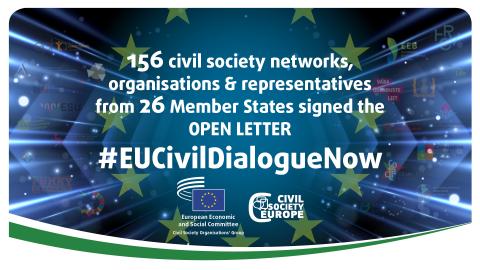
A carta aberta foi lançada pelo Grupo das Organizações da Sociedade Civil do Comité Económico e Social Europeu (CESE) e pela Sociedade Civil Europa e inclui propostas específicas de aplicação. A carta obteve o apoio de um total de 156 signatários de 26 Estados-Membros. Os signatários incluíram 39 redes europeias, 85 organizações nacionais e 60 membros do Grupo das Organizações da Sociedade Civil do CESE.
O diálogo civil continua a ser fragmentado e não estruturado em todas as instituições da UE, apesar das disposições jurídicas. É por esta razão que os signatários da carta aberta #EUCivilDialogueNow apelam às instituições da UE para que:
- iniciem o processo com vista à assinatura de um acordo interinstitucional sobre o diálogo civil;
- criem, em cada instituição, cargos de liderança responsáveis pelas relações com a sociedade civil;
- incentivem e promovam uma maior cooperação entre os agentes cívicos e sociais,
cujos esforços devem ter por base as recomendações da Conferência sobre o Futuro da Europa. Como primeiro passo os signatários recomendaram a publicação de uma comunicação da Comissão Europeia sobre o reforço do diálogo civil a nível da UE.
A carta aberta está disponível em 24 línguas no seguinte endereço: https://www.eesc.europa.eu/pt/agenda/our-events/events/eu-civil-dialogue-now/open-letter.
Para mais informações, consultar o comunicado de imprensa anunciando a carta aberta, disponível em 24 línguas no seguinte endereço: https://www.eesc.europa.eu/pt/agenda/our-events/events/eu-civil-dialogue-now.