Geilleagar ciorclach

This page is also available in:

Tá an t-aistriú chuig geilleagar ciorclach chun tosaigh ar chlár oibre CESE mar réiteach chun an ghéarchéim aeráide a chomhrac agus chun ár bpláinéad a chosaint. Is deis iontach í don tsochaí shibhialta mar go gcuideoidh sé leis an méid seo a leanas a dhéanamh:

  • iomaíochas thionscal na hEorpa a mhéadú;
  • an fás eacnamaíoch inbhuanaithe a chur chun cinn;
  • poist nua a chruthú.

Ní hamháin go bhfuil acmhainní á gcur amú le samhail an táirgthe agus an tomhaltais línigh (‘é a thógáil, é a dhéanamh agus é a chaitheamh uainn’) atá fós chun tosaigh sa gheilleagar sa lá atá inniu ann, ach baintear an bonn den chomhrac i gcoinne an athraithe aeráide mar gheall uirthi freisin. Murab ionann agus an geilleagar líneach, tá an geilleagar ciorclach bunaithe ar chur chuige athghiniúnach agus aisiríoch lena ndírítear ar luach eacnamaíoch a chruthú agus a choinneáil, agus ar dhúshláin chomhshaoil dhomhanda a chomhrac amhail an t-athrú aeráide, cailliúint na bithéagsúlachta agus truailliú, agus tairbhí eacnamaíocha á mbaint amach san am céanna.

Is é an dea-scéala ná go bhfuil an t-aistriú ciorclach ag tarlú cheana féin ar an leibhéal áitiúil. Tá roinnt mhaith tionscnaimh chiorclacha á gcruthú agus á gcur chun feidhme ag geallsealbhóirí ón tsochaí shibhialta, lena n-áirítear gnólachtaí, ceardchumainn, lucht acadúil agus pobail eolais, eagraíochtaí don óige chomh maith le heagraíochtaí neamhrialtasacha agus grúpaí leasmhara eile ar an leibhéal áitiúil agus réigiúnach. Trí réitigh chiorclacha agus ceannaireacht na ngeallsealbhóirí leasmhara a spreagadh is fearr is féidir leis an Eoraip an t-aistriú chuig geilleagar ciorclach a chur chun cinn.

Dá réir sin, is ardán é Ardán Eorpach Gheallsealbhóirí an Gheilleagair Chiorclaigh, ar tionscnamh comhpháirteach é ó CESE agus ón gCoimisiún Eorpach, a bunaíodh in 2017 chun pobal an gheilleagair chiorclaigh san Eoraip a thabhairt le chéile. Tacaíonn an t-ardán atá dírithe ar gheallsealbhóirí le haistriú na hEorpa i dtreo geilleagar ciorclach trí idirphlé a chothú, eolas a roinnt agus dea-chleachtais a mhalartú.

  • In an annual conference held entirely online on 3-4 November, the European Economic and Social Committee (EESC) voiced its determination to help make the Circular Economy Platform a real hub of the collective effort to build a circular economy in Europe.

  • The COVID-19 crisis has created the conditions for circular products and services to become the norm in Europe, says the EESC. In a recent opinion on the new EU Circular Economy Action Plan, the EESC urges lawmakers to ensure the circular economy finds a place and resources in the overall "greenprint" for Europe's recovery.

  • Public debate
    Event type
    Debate

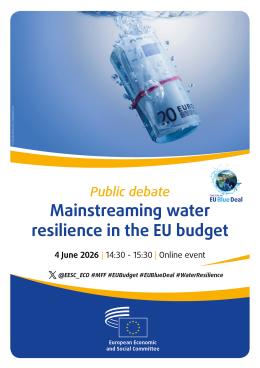
    Mainstreaming Water Resilience in the EU Budget is a timely discussion on securing Europe’s water future. Discover how smarter EU investments can strengthen water resilience, sustainability, and preparedness, and how we should shape tomorrow’s funding priorities across programmes in the context of the EU´s next Multiannual Financial Framework.

  • Driving Sustainability and Competitiveness
    Event type
    Debate

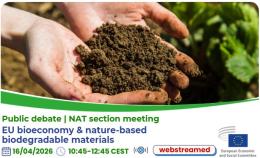
    The debate will explore how the EU can strengthen its bioeconomy strategy and scale up the use of nature-based biodegradable materials to advance circularity, resource efficiency, and sustainability. 

  • Rural Pact debate #6

    This event will explore how circular economy and bioeconomy can drive sustainable agri-food systems development across both rural and urban areas in the EU, through the presentation of innovative approaches that support the balanced development of rural and urban communities

  • Event type
    Public hearing

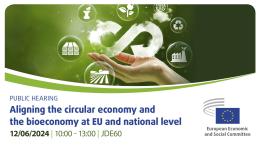
    On 12 June 2024, the EESC will hold a public hearing in connection with its ongoing opinion on Aligning the circular economy and the bioeconomy at EU and national level which aims to enhance the synergy between bioeconomy, circularity, and sustainability by adopting a more integrated and systemic perspective on the circular bioeconomy.

  • Debate
    Event type
    Debate

    The EESC is convinced that islands, mountainous regions and sparsely populated areas face significant challenges and that there is a solid legal basis that obliges the EU to take action in order to tackle these challenges. In this context, the organised civil society has an important role to play and through this debate, the aim is to find the best practices and solutions so that these regions can perform better and recover from the multiple crises. Therefore the EESC- ECO section has decided to organise this public debate in the framework of the EESC own-intiative opinion on "Main challenges that EU islands, mountain and sparsely populated areas face.

  • Event type
    Debate

    Insularity is considered to be a permanent and unchangeable geographical feature which involves additional costs (transport, energy, waste management, public services, necessity goods and services) that hamper the development and competitiveness of the islands, while particularly exposing them to biodiversity loss and climate change. The organised civil society has an important role to play and tackle all these challenges and through this debate. The aim is to find the best practices and solutions so that EU islands can preform better and recover from the multiple crises.

  • How can these regions become drivers for growth and development?
    Event type
    Public hearing

    The European Economic and Social Committee (EESC) will be producing an own-initiative opinion on the main challenges faced by EU islands and mountainous and sparsely populated areas, which is scheduled for adoption at the EESC's September plenary session. In this context, the EESC, along with the Conference of Peripheral Maritime Regions (CPMR) and the North Sweden European Office (NSEO), will be holding a public hearing in Umeå (Sweden) on 4 May 2023 entitled "Challenges and opportunities that the digital and energy transitions present to the northern sparsely populated areas and islands. How can these regions become drivers for growth and development?". The hearing is an event under the Swedish Presidency of the Council of the EU.

  • An economically sustainable Europe
    Event type
    Debate

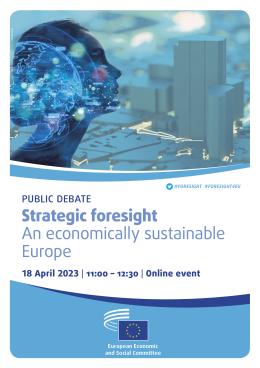
    With this debate, the ECO section is providing ex-ante input to the European Commission, in preparation for the upcoming 2023 strategic foresight cycle that wants to shed light on the strategic decisions needed to ensure a socially and economically sustainable Europe with a stronger role in the world in the coming decades.