
European Economic
and Social Committee
Energy transition – trust and fair procedures will increase social acceptance
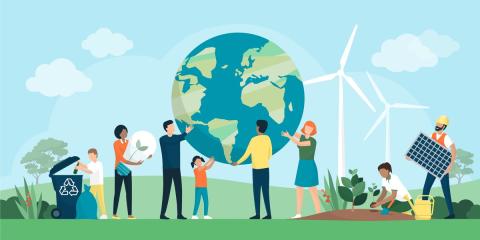
Transparent decision-making and open communication will make the energy transition more acceptable to society despite the potentially higher initial costs, underlines the European Economic and Social Committee (EESC). The EU should push for fair distribution and "prosumption" by tapping into the potential of financial incentives, identifying and removing any obstacles to public participation and support.
Building mutual trust with all stakeholders is essential to make the energy and low-carbon transition socially acceptable. In the opinion drawn up by Arnaud Schwartz and Pierre Jean Coulon and adopted at the March plenary session the message is clear: fair procedures and engaging in dialogue with local populations will make Europeans aware of the benefits of change and therefore keen to participate in and own the process.
All energy transition-related measures require open communication and full participation as early as possible in project development at all appropriate levels, from the EU to local government,
said Mr Schwartz.
Backing this position, Mr Coulon added: Support from civil society is, indeed, extremely important to secure the community's ownership as local organisations can contribute to the public debate more easily and fight with scientific data any false ideas that might circulate.
Fair governance of the energy transition
The European Union needs the energy transition because it is individually and collectively fairer and cleaner and will be cheaper for citizens in the long term. However, it requires individual and collective changes and, in the short term, decarbonising may entail higher costs for producers and higher prices for consumers.
It is therefore key that the population and all stakeholders increase their levels of mutual trust and accept the transformation and its technical changes, from the planning to the implementation stages. For this, the process has to be independent, transparent and inclusive, information provided should be high quality and easily accessible, and decision-makers should be accountable.
It is also crucial that plans and projects are monitored all the way through, from cradle to grave, to ensure that they are affordable and work well. For example, practical solutions such as charging points for electric vehicles must be well located and sufficiently numerous.
Access to financial incentives must be straightforward
Another important step is achieving the main objective of the Energy Union much faster. The policy must be truly people-focused, enabling Europeans to easily become energy producers and benefit from new technologies.
To make progress on this side, the European Union should do much more to promote fair distribution and "prosumption" by providing financial incentives, as this is the factor which impacts the most on local acceptance, making them accessible and simple to request.
The benefits, as well as the perceived costs of a project, should also be fairly distributed within a community.
Stepping up participation
Participation is yet one more vital element which could contribute to making the energy transition socially acceptable and should reflect freedom, diversity and be based on clear arrangements.
In the EESC's view, the EU must identify and remove any obstacles responsible for poor public involvement and support in project development and planning decisions, setting up a specific action plan to facilitate participation and address issues such as lack of time, citizenship education, and accountability of the authorities concerned.
Special attention must also be given to measures such as lifelong learning, reskilling and upskilling of the workforce, business support, and information campaigns targeting the different groups involved.
If the EU really wants to advance towards greater social acceptability and achieve the energy transition objectives at a good pace, it is essential to increase, on the one hand, careful coordination between objectives and planning, and, on the other, consultation and even joint development with the public, in particular social partners and civil society organisations.
Work organisation
Recommended for you
„Sinu Euroopa, Sinu arvamus“ 2023: noored soovivad läbipaistvamat, digitaalsemat ja lihtsamat ELi
News
23. ja 24. märtsil korraldas Euroopa Majandus- ja Sotsiaalkomitee 14. korda ürituse „Sinu Euroopa, Sinu arvamus“. Üritus tõi Brüsselisse 105 õpilast 35 koolist kõigist 27…
Algab kandideerimine Euroopa Majandus- ja Sotsiaalkomitee kodanikuühiskonna auhinnale, mille teemaks on vaimne tervis
News
Kodanikuühiskonna organisatsioonid, üksikisikud ja eraettevõtted saavad nüüd esitada oma mittetulunduslikke projekte, et konkureerida Euroopa Majandus- ja Sotsiaalkomitee auhinnale, mis on pühendatud…
Valimised 2024. aasta juunis: Euroopa Majandus- ja Sotsiaalkomitee kutsub eurooplasi üles hääletama ühtse ja demokraatliku Euroopa poolt
News
Uue Euroopa Parlamendi valimistel on palju kaalul, sest demokraatia on nõrgenemas kogu maailmas, desinformatsioon on laialt levinud ja rahulolematus kasvab, kuna inflatsioon kiireneb ja sõjaoht…
TENi sektsiooni esimees Baiba Miltoviča ja Euroopa Regioonide Komitee raportöör Andres Jaadla kirjutavad alla elamumajandust käsitlevale deklaratsioonile
News
14. novembril 2024 allkirjastatud ühisavalduses kutsuvad Euroopa Majandus- ja Sotsiaalkomitee transpordi, energeetika, infrastruktuuri ja infoühiskonna sektsiooni (TEN) esimees Baiba…
EL peab transpordisektori CO2 heite vähendamiseks viivitamatult keskenduma saastevabale vesinikule
News
Eestis toimunud konverentsil rõhutati, et vähese CO2 heitega vesinik on energiasüsteemi eduka ümberkujundamise põhielement, mille potentsiaali arendamiseks on aga vaja taristut ja rahastamist.Ürituse…