
European Economic
and Social Committee
Energy transition – trust and fair procedures will increase social acceptance
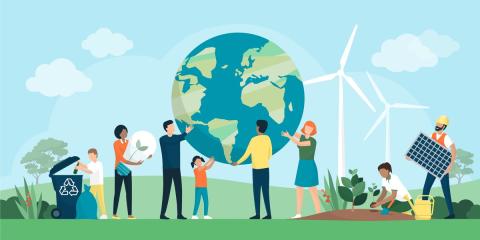
Transparent decision-making and open communication will make the energy transition more acceptable to society despite the potentially higher initial costs, underlines the European Economic and Social Committee (EESC). The EU should push for fair distribution and "prosumption" by tapping into the potential of financial incentives, identifying and removing any obstacles to public participation and support.
Building mutual trust with all stakeholders is essential to make the energy and low-carbon transition socially acceptable. In the opinion drawn up by Arnaud Schwartz and Pierre Jean Coulon and adopted at the March plenary session the message is clear: fair procedures and engaging in dialogue with local populations will make Europeans aware of the benefits of change and therefore keen to participate in and own the process.
All energy transition-related measures require open communication and full participation as early as possible in project development at all appropriate levels, from the EU to local government,
said Mr Schwartz.
Backing this position, Mr Coulon added: Support from civil society is, indeed, extremely important to secure the community's ownership as local organisations can contribute to the public debate more easily and fight with scientific data any false ideas that might circulate.
Fair governance of the energy transition
The European Union needs the energy transition because it is individually and collectively fairer and cleaner and will be cheaper for citizens in the long term. However, it requires individual and collective changes and, in the short term, decarbonising may entail higher costs for producers and higher prices for consumers.
It is therefore key that the population and all stakeholders increase their levels of mutual trust and accept the transformation and its technical changes, from the planning to the implementation stages. For this, the process has to be independent, transparent and inclusive, information provided should be high quality and easily accessible, and decision-makers should be accountable.
It is also crucial that plans and projects are monitored all the way through, from cradle to grave, to ensure that they are affordable and work well. For example, practical solutions such as charging points for electric vehicles must be well located and sufficiently numerous.
Access to financial incentives must be straightforward
Another important step is achieving the main objective of the Energy Union much faster. The policy must be truly people-focused, enabling Europeans to easily become energy producers and benefit from new technologies.
To make progress on this side, the European Union should do much more to promote fair distribution and "prosumption" by providing financial incentives, as this is the factor which impacts the most on local acceptance, making them accessible and simple to request.
The benefits, as well as the perceived costs of a project, should also be fairly distributed within a community.
Stepping up participation
Participation is yet one more vital element which could contribute to making the energy transition socially acceptable and should reflect freedom, diversity and be based on clear arrangements.
In the EESC's view, the EU must identify and remove any obstacles responsible for poor public involvement and support in project development and planning decisions, setting up a specific action plan to facilitate participation and address issues such as lack of time, citizenship education, and accountability of the authorities concerned.
Special attention must also be given to measures such as lifelong learning, reskilling and upskilling of the workforce, business support, and information campaigns targeting the different groups involved.
If the EU really wants to advance towards greater social acceptability and achieve the energy transition objectives at a good pace, it is essential to increase, on the one hand, careful coordination between objectives and planning, and, on the other, consultation and even joint development with the public, in particular social partners and civil society organisations.
Work organisation
Recommended for you
Skrajni čas za vlaganje v mlade na Zahodnem Balkanu
News
Da bi vlade držav Zahodnega Balkana svojim državljanom zagotovile boljšo prihodnost, se morajo lotiti reševanja težav, s katerimi se srečujejo mladi, ki imajo ključno vlogo pri njenem ustvarjanju.…
Vaša Evropa, vaš glas! v letu 2023: Mladi si želijo, da bi bila EU preglednejša, bolj digitalna in enostavnejša
News
Evropski ekonomsko-socialni odbor (EESO) je 23. in 24. marca gostil dogodek Vaša Evropa, vaš glas! Potekal je v Bruslju, udeležilo pa se ga je 105 dijakov 35 šol iz vseh 27 držav članic EU in sedem…
Začetek zbiranja prijav za nagrade za civilno družbo EESO na temo duševnega zdravja
News
Organizacije civilne družbe, posamezniki in zasebna podjetja lahko svoje nepridobitne projekte prijavijo za nagrado EESO, namenjeno spodbujanju duševnega zdravja Evropejcev Evropski ekonomsko…
Oddajte svoj glas junija 2024: EESO poziva Evropejce, naj volijo za enotno in demokratično Evropo
News
Demokracija po vsem svetu nazaduje, širijo se dezinformacije in vse več je nezadovoljstva zaradi naraščajoče inflacije ter preteče nevarnosti vojne, zato so letošnje evropske volitve, na katerih bodo…
Ohranjanje zagona širitve EU: prizadevanje civilne družbe, da bi s postopnim vključevanjem prinesla koristi Zahodnemu Balkanu
News
Evropski ekonomsko-socialni odbor (EESO) je 20 let po pristopu Slovenije k EU v Ljubljani zbral politične voditelje in voditelje civilne družbe, da bi obeležili to simbolično obletnico in poudarili…