
European Economic
and Social Committee
EESC concludes its term of office emphasising the valuable contribution of organised civil society to the European project
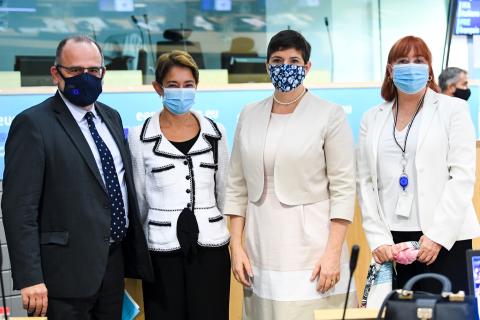
On 17 September, the European Economic and Social Committee (EESC) hosted its end-of-term ceremony during the last plenary session before the renewal of the institution in October. Luca Jahier, president of the EESC since April 2018, expressed his gratitude to all of the members and highlighted the important contribution of the civil society organisations represented at the EESC to the European project.
The EESC said goodbye to 135 of its current members yesterday during its September plenary session, the last of the 2015-2020 term. In October, a new five-year term will start under a new presidency and the partial renewal of the members.
The outgoing president, Luca Jahier, took stock of the work done during his term of office, which started in April 2018 with a call for a second European Renaissance or "rEUnaissance". I continue to believe that the EESC has an important role to play in shaping the key transformations the EU has to face, as a powerhouse of this
rEUnaissance, said Mr Jahier.
In his last speech as president of the EESC, Mr Jahier spoke about the main priorities of his term, namely sustainable development, a strengthened EU-Africa relationship, EU enlargement, and culture as a unifying element in Europe. He also highlighted the contribution made by the EESC in the last few years to tackling the challenges facing the EU: for example, the EESC had been the first European institution to propose a European Health Union. He expressed the hope that the EESC could take an active part in the Conference on the Future of Europe proposed by the European Commission and the European Parliament.
Luca Jahier closed his speech with a warning: I call for the EESC to stay united; there seems to be a fear of change, but we must remember that only by daring to do things differently can you create something new. Europe is at a crossroads and we must act fast, but make sure to leave no one behind
.
Isabel Caño Aguilar, the outgoing Vice-president for Communication, mentioned the major challenges that the EU institutions had had to face in the last few years, which included the European elections, the renewal of the Commission, Brexit, and the ongoing COVID-19 pandemic, and also referred to the efforts the Committee had made to modernise and update our communication policy
. Against this background, Isabel Caño outlined the important contribution made by EESC members to communicating the role of organised civil society and expressed her firm belief that another Europe is possible, citizens' rights and aspirations must be at the core of our work; Europe is its civil society
.
In her speech, the Vice-president for the Budget Milena Angelova highlighted some of the main achievements of her term: We managed to distribute our resources in a balanced way, and we strengthened cooperation with other EU institutions, such as the Parliament and the Council; I think we are leaving a good legacy for our successors
, she said.
Institutional support
The president of the European Commission, Ursula von der Leyen, could not attend the plenary but sent a video message praising the excellent work
done by the EESC in the last five years and its important contribution to the EU legislative procedure. I'm looking forward to cooperating closely with you at the Conference on the Future of Europe. The EESC has an important role to play in feeding into the debate
, said Ms von der Leyen.
David Sassoli, President of the European Parliament, also sent a video message inviting the EESC and all EU institutions to cooperate to consolidate their democratic legitimacy
. Mr Sassoli also expressed his willingness to work more closely with the EESC to create a structured dialogue with organised civil society.
The Vice-President of the European Commission and Commissioner for Interinstitutional Relations and Foresight, Maroš Šefčovič, also sent a video message highlighting the high importance
the Commission attaches to the voice of organised civil society and the important role the EESC plays as a contact point with reality on the ground.
Klara Dobrev, Vice-President of the European Parliament, took the floor at the EESC's plenary to highlight that nothing can change in the world if we don't have the support of the people; and the role of the EESC is to get in touch with organised civil society, with real people, all with different backgrounds and needs
.
Italian writer and journalist Giuliano da Empoli, founding chairman of the Volta think tank, explored the issue of how to better communicate the European project, and pointed out that on social media, it is the adversaries of Europe and the nationalists who are the establishment, and they use very sophisticated, contemporary tools
. He also proposed that the taboo of neutral communication should be broken, as controversy and disagreement will create more energy
.
Future steps
On 27-29 October, the EESC will hold the first plenary session of its new term of office, which will include the inauguration of the new presidency and the arrival of the new members to replace those whose term has not been renewed.
Under the rotating system of the EESC, the new president will come from the Employers' Group and will hold the position for two and a half years. The EESC plenary will also appoint two vice-presidents chosen from each of the two other groups in rotation, one from the Workers' Group who will be responsible for the budget and one from the Diversity Europe Group in charge of communication.
The new president will be responsible for the orderly conduct of the Committee's business and represent the EESC in relations with outside bodies.
Work organisation
Related content
Downloads
-
PR 24 2020 - EESC concludes its term of office emphasising the valuable contribution of organised civil society to the European project
-
PR 24 - El CESE concluye su mandato haciendo hincapié en la valiosa contribución de la sociedad civil organizada al proyecto europeo
-
PR 24 - Il CESE conclude il suo mandato sottolineando il prezioso contributo della società civile organizzata al progetto europeo
-
PR 24 - ЕИСК приключва мандата си, като подчертава ценния принос на организираното гражданско общество към европейския проект.
-
Le CESE conclut son mandat en soulignant la précieuse contribution de la société civile organisée au projet européen
Recommended for you
Η εργαλειοποίηση των μεταναστών και η προσφυγική κρίση της Ουκρανίας επιβάλλουν ένα νέο ξεκίνημα για τη μεταναστευτική πολιτική
News
Η κρατική εργαλειοποίηση των μεταναστών, που αποσκοπεί στην αποσταθεροποίηση της ΕΕ, και ο τρέχων πόλεμος στην Ουκρανία, που οδηγεί σε πρωτόγνωρη εισροή προσφύγων, επιβάλλουν την επανεξέταση της…
YEYS! 2023: Οι νέοι ζητούν μια πιο διαφανή, ψηφιακή και απλοποιημένη ΕΕ
News
Στις 23 και 24 Μαρτίου, η Ευρωπαϊκή Οικονομική και Κοινωνική Επιτροπή (ΕΟΚΕ) φιλοξένησε την 14η διοργάνωση της εκδήλωσης «Η δική σου Ευρώπη, η δική σου φωνή!» (YEYS!), η οποία προσέλκυσε στις…
Η ΕΕ χρειάζεται αποτελεσματικότερη πολυμέρεια για την αντιμετώπιση των κινδύνων που σχετίζονται με την ασφάλεια στη θάλασσα, επισημαίνει η ΕΟΚΕ
News
Η Ευρωπαϊκή Οικονομική και Κοινωνική Επιτροπή (ΕΟΚΕ) ζητεί περισσότερες κοινές δράσεις σχετικά με τη στρατηγική της ΕΕ για την ασφάλεια στη θάλασσα και το σχετικό σχέδιο δράσης, που αποσκοπούν στη…
Η ΕΟΚΕ δρομολογεί τη διαδικασία υποβολής υποψηφιοτήτων για το Βραβείο της Κοινωνίας των Πολιτών, το οποίο θα αφορά την ψυχική υγεία
News
Οι οργανώσεις της κοινωνίας των πολιτών, οι ιδιώτες και οι ιδιωτικές εταιρείες μπορούν τώρα να υποβάλουν τα μη κερδοσκοπικά έργα τους για το βραβείο της ΕΟΚΕ που είναι αφιερωμένο στη στήριξη της…
#ReskillEU — Το εργατικό δυναμικό της Ευρώπης στους τομείς της ενέργειας και των μεταφορών χρειάζεται νέες δεξιότητες για να κάνει πραγματικότητα την απανθρακοποίηση
News
Για να επιτύχει η απανθρακοποίηση των τομέων της ενέργειας και των μεταφορών της ΕΕ, οι εν λόγω τομείς χρειάζονται εργαζομένους εξοπλισμένους με «νέες» δεξιότητες, προειδοποιεί η Ευρωπαϊκή Οικονομική…