European Economic
and Social Committee
European Economic
and Social Committee
The European Economic and Social Committee (EESC) is the voice of organised civil society in Europe.
Find out more about its role and structure at http://www.eesc.europa.eu/en/about
The EESC issues between 160 and 190 opinions, evaluation and information reports a year.
It also organises several annual initiatives and events with a focus on civil society and citizens’ participation such as the Civil Society Prize, the Civil Society Days, the Your Europe, Your Say youth plenary and the ECI Day.
Find the latest EESC opinions and publications at http://www.eesc.europa.eu/en/our-work/opinions-information-reports/opinions and http://www.eesc.europa.eu/en/our-work/publications-other-work/publications respectively.
The EESC is active in a wide range of areas, from social affairs to economy, energy and sustainability.
Learn more about our policy areas and policy highlights at http://www.eesc.europa.eu/en/policies
The EESC holds nine plenary sessions per year. It also organises many conferences, public hearings and high-level debates related to its work.
Find out more about our upcoming events at http://www.eesc.europa.eu/en/agenda/our-events/upcoming-events
Here you can find news and information about the EESC'swork, including its social media accounts, the EESC Info newsletter, photo galleries and videos.
Read the latest EESC news http://www.eesc.europa.eu/en/news-media/news and press releases http://www.eesc.europa.eu/en/news-media/press-releases
The EESC brings together representatives from all areas of organised civil society, who give their independent advice on EU policies and legislation. The EESC's326 Members are organised into three groups: Employers, Workers and Various Interests.
Find out more about our Members and groups at http://www.eesc.europa.eu/en/members-groups
The EESC has six sections, specialising in concrete topics of relevance to the citizens of the European Union, ranging from social to economic affairs, energy, environment, external relations or the internal market.
Find out more at http://www.eesc.europa.eu/en/sections-other-bodies
EHSV přijal nové usnesení o zapojení organizované občanské společnosti do provádění a monitorování národních plánů pro oživení a odolnost. Nedávná konzultace ukázala, že navzdory nařízení není organizovaná občanská společnost do těchto plánů dostatečně zapojena.
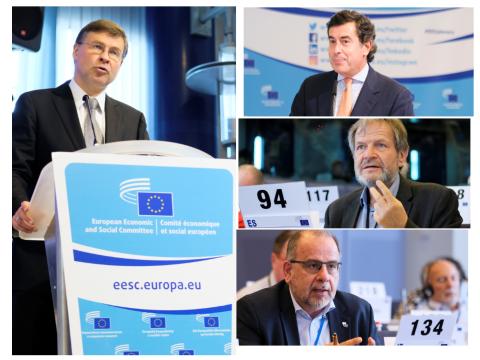
Výbor požaduje jasná pravidla, která by tuto situaci účinně napravila a pomohla znovu nastartovat ekonomiku. Předsedkyně EHSV Christa Schweng během diskuse předcházející přijetí zdůraznila, že zapojení organizované občanské společnosti do reforem stanovených v národních plánech pro oživení a odolnost je nezbytným předpokladem pro zlepšení kvality, transparentnosti a provádění nových politik. Místopředseda skupiny ad hoc Evropský semestr Gonçalo Lobo Xavier informoval o některých klíčových zjištěních konzultace.
Poukázal na to, že „konečný obsah národních plánů pro oživení a odolnost hodnotí organizovaná občanská společnost obecně kladně, sociální rozměr je však často málo propracovaný.“ Předseda uvedené skupiny Javier Doz Orrit pak představil hlavní doporučení. Vyzval rovněž členské státy, aby „bezpodmínečně postupovaly v souladu s pravidly stanovenými v nařízení o Nástroji pro oživení a odolnost“, a Evropskou komisi a Parlament, aby vymáhaly jejich dodržování. Místopředseda skupiny ad hoc Evropský semestr Luca Jahier seznámil členy s některými osvědčenými postupy a uvedl, že „nedostatečně účinná a nedostatečně kvalitní účast organizované občanské společnosti na správě ekonomických záležitostí EU nebude vyřešena, dokud neproběhne reforma evropského semestru.“
Výkonný viceprezident Evropské komise Valdis Dombrovskis, který se debaty rovněž zúčastnil, poukázal na dopad ruské invaze na Ukrajinu na globální ekonomické oživení a EU a na to, co je zapotřebí, abychom se z ní vzpamatovali a posunuli se dál.“ (tk)