European Economic
and Social Committee
European Economic
and Social Committee
The European Economic and Social Committee (EESC) is the voice of organised civil society in Europe.
Find out more about its role and structure at http://www.eesc.europa.eu/en/about
The EESC issues between 160 and 190 opinions, evaluation and information reports a year.
It also organises several annual initiatives and events with a focus on civil society and citizens’ participation such as the Civil Society Prize, the Civil Society Days, the Your Europe, Your Say youth plenary and the ECI Day.
Find the latest EESC opinions and publications at http://www.eesc.europa.eu/en/our-work/opinions-information-reports/opinions and http://www.eesc.europa.eu/en/our-work/publications-other-work/publications respectively.
The EESC is active in a wide range of areas, from social affairs to economy, energy and sustainability.
Learn more about our policy areas and policy highlights at http://www.eesc.europa.eu/en/policies
The EESC holds nine plenary sessions per year. It also organises many conferences, public hearings and high-level debates related to its work.
Find out more about our upcoming events at http://www.eesc.europa.eu/en/agenda/our-events/upcoming-events
Here you can find news and information about the EESC'swork, including its social media accounts, the EESC Info newsletter, photo galleries and videos.
Read the latest EESC news http://www.eesc.europa.eu/en/news-media/news and press releases http://www.eesc.europa.eu/en/news-media/press-releases
The EESC brings together representatives from all areas of organised civil society, who give their independent advice on EU policies and legislation. The EESC's326 Members are organised into three groups: Employers, Workers and Various Interests.
Find out more about our Members and groups at http://www.eesc.europa.eu/en/members-groups
The EESC has six sections, specialising in concrete topics of relevance to the citizens of the European Union, ranging from social to economic affairs, energy, environment, external relations or the internal market.
Find out more at http://www.eesc.europa.eu/en/sections-other-bodies
The EESC has adopted a new resolution on the involvement of organised civil society in the implementation and monitoring of the National Recovery and Resilience Plans (NRRPs). A recent consultation shows that, contrary to regulation, organised civil society is not involved enough in these plans.
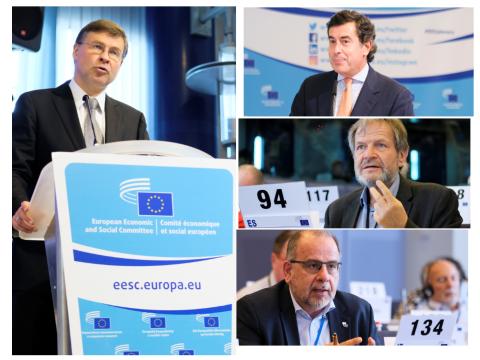
The Committee calls for clear rules to effectively remedy this, and bring the economy back on track. During the adoption debate, EESC President Christa Schweng pointed out that involving organised civil society in the reforms set up in the NRRPs, is a must for improving the quality, transparency and the implementation of new policies. Gonçalo Lobo Xavier, European Semester Group vice-president, shared some of the key findings of the consultation.
"The final content of the NRRPs is generally assessed positively by organised civil society. However, the social dimension is often underdeveloped", he pointed out. ESG president, Javier Doz Orrit, presented the main recommendations. He also called on the Member States "to urgently comply with the rules laid down in the Recovery and Resilience Facility", and the European Commission and Parliament to enforce this. ESG vice-president, Luca Jahier, shared some good practices, and said that "the lack of effective and quality participation of organised civil society in the economic governance of the EU will not be resolved until there is a reform of the European Semester".
Valdis Dombrovskis, Executive Vice President of the European Commission, who also took part in the debate, highlighted the impact of Russia’s invasion of Ukraine on the global economic recovery and the EU, and what is needed to absorb it and move on. (tk)