European Economic
and Social Committee
European Economic
and Social Committee
The European Economic and Social Committee (EESC) is the voice of organised civil society in Europe.
Find out more about its role and structure at http://www.eesc.europa.eu/en/about
The EESC issues between 160 and 190 opinions, evaluation and information reports a year.
It also organises several annual initiatives and events with a focus on civil society and citizens’ participation such as the Civil Society Prize, the Civil Society Days, the Your Europe, Your Say youth plenary and the ECI Day.
Find the latest EESC opinions and publications at http://www.eesc.europa.eu/en/our-work/opinions-information-reports/opinions and http://www.eesc.europa.eu/en/our-work/publications-other-work/publications respectively.
The EESC is active in a wide range of areas, from social affairs to economy, energy and sustainability.
Learn more about our policy areas and policy highlights at http://www.eesc.europa.eu/en/policies
The EESC holds nine plenary sessions per year. It also organises many conferences, public hearings and high-level debates related to its work.
Find out more about our upcoming events at http://www.eesc.europa.eu/en/agenda/our-events/upcoming-events
Here you can find news and information about the EESC'swork, including its social media accounts, the EESC Info newsletter, photo galleries and videos.
Read the latest EESC news http://www.eesc.europa.eu/en/news-media/news and press releases http://www.eesc.europa.eu/en/news-media/press-releases
The EESC brings together representatives from all areas of organised civil society, who give their independent advice on EU policies and legislation. The EESC's326 Members are organised into three groups: Employers, Workers and Various Interests.
Find out more about our Members and groups at http://www.eesc.europa.eu/en/members-groups
The EESC has six sections, specialising in concrete topics of relevance to the citizens of the European Union, ranging from social to economic affairs, energy, environment, external relations or the internal market.
Find out more at http://www.eesc.europa.eu/en/sections-other-bodies
EESO je sprejel novo resolucijo o vključevanju organizirane civilne družbe v izvajanje in spremljanje nacionalnih načrtov za okrevanje in odpornost. Iz nedavnega posvetovanja je razvidno, da je organizirana civilna družba kljub predpisom premalo vključena v te načrte.
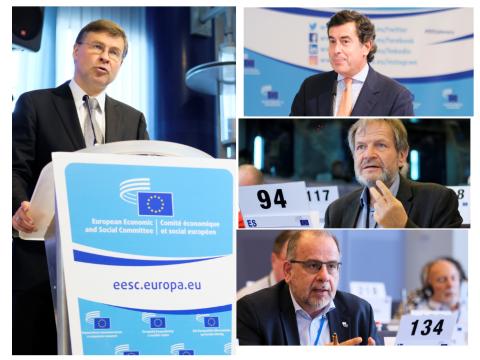
Odbor poziva k jasnim pravilom, s katerimi bi to učinkovito odpravili in ponovno oživili gospodarstvo. Predsednica EESO Christa Schweng je med razpravo pred sprejetjem resolucije poudarila, da je vključevanje organizirane civilne družbe v reforme, opredeljene v nacionalnih načrtih za okrevanje in odpornost, nujno za izboljšanje kakovosti, preglednosti in izvajanja novih politik. Gonçalo Lobo Xavier, podpredsednik skupine za evropski semester, je predstavil nekatere ključne ugotovitve posvetovanja.
„Organizirana civilna družba na splošno pozitivno oceni končno vsebino nacionalnih načrtov za okrevanje in odpornost. Vendar je socialna razsežnost pogosto slabo razvita,“ je poudaril. Predsednik skupine za evropski semester, Javier Doz Orrit, je predstavil glavna priporočila in pozval države članice, naj „nujno spoštujejo pravila iz uredbe o mehanizmu za okrevanje in odpornost“, ter Evropsko komisijo in Parlament, naj to izvršita. Podpredsednik skupine za evropski semester, Luca Jahier, je predstavil nekaj primerov dobre prakse in dejal, da „pomanjkanje učinkovite in kakovostne udeležbe organizirane civilne družbe pri gospodarskem upravljanju EU ne bo rešeno, dokler ne bo izvedena reforma evropskega semestra.“
V razpravi je sodeloval tudi izvršni podpredsednik Evropske komisije, Valdis Dombrovskis, ki je poudaril vpliv ruske invazije v Ukrajini na okrevanje gospodarstva EU in svetovnega gospodarstva ter kaj je potrebno za ublažitev tega vpliva in nadaljnje korake. (tk)