
European Economic
and Social Committee
Séamus Boland elected as new President of the European Economic and Social Committee, pledging to put civil society at the heart of Europe
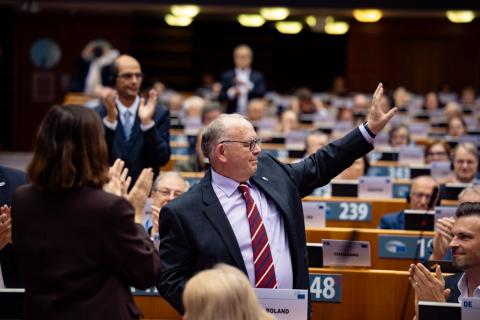
Ireland’s Séamus Boland has been elected the 35th President of the European Economic and Social Committee (EESC) for the 2025–2028 term of office. A lifelong advocate for rural communities and social inclusion, he will guide the EU body representing organised civil society for two and a half years. His programme is devoted to providing opportunities through poverty eradication, securing democracy by protecting civic space, and ensuring the transition to a more competitive and green economy in a way that doesn’t leave anyone behind.
Mr Boland’s election comes at a moment of overlapping challenges in Europe, from conflict and global instability to climate change, biodiversity loss, and persistent social inequality. He argues that the EU must confront these pressures without losing its democratic core.
'All my life, civil society has been at the centre of my heart. Now, I want to put civil society at the heart of Europe. People cannot participate fully in society if they are excluded, if there is shrinking civic space, if their security is under threat, or if our economies are not resilient. My vision as President of the EESC is of an EU of opportunities, security and resilience, that together we can help deliver,' said EESC President Séamus Boland.
A member of the EESC since 2011, Mr Boland has served as President of the EESC Civil Society Organisations’ Group from 2020 until now, in 2025. Outside the Committee, he is Chief Executive Officer of Irish Rural Link, Ireland’s leading network for rural development, which represents thousands of communities and organisations across the country. He also serves on several national boards, including the Peatlands Council and Inland Fisheries Ireland.
Throughout his career, he has championed groups often left behind. These include rural communities, young people, minorities, and disadvantaged members of society. As EESC President, he pledges to bring their voices to Brussels and across the EU.
Under the motto 'Civil Society at the Heart of Europe,' the new EESC President has set out an ambitious programme structured around three pillars: Opportunities, Security and Resilience. He aims to tackle poverty, defend democracy, strengthen civic participation, and ensure a fair and green transition that reaches all communities.
Joining him in leadership are Alena Mastantuono from the Czech Republic, as Vice-President for the Budget, and Marija Hanževački from Croatia, as Vice-President for Communication.
A Union of Opportunities
The new EESC President's top priority is a Europe where everyone can thrive, regardless of their background or location. His programme seeks to balance economic growth with social inclusion and equal access to opportunities. Fighting poverty will be central to this effort.
His programme will push for coordinated action on in-work poverty and child poverty, strengthen youth engagement in policymaking, protect the emotional health of young people and children, and support vulnerable groups in rural and urban areas alike. He also proposes initiatives to boost SME-driven job creation and ensure that social rights, housing, and disability policies reach those most in need.
A Union of Security
Democracy and civic space are under pressure across Europe. The second pillar focuses on protecting these core values. The EESC will reinforce media freedom, counter disinformation, and expand civic dialogue, including with communities in Ukraine and candidate countries.
The new EESC President aims to make the Committee a high-profile guardian of democratic participation and a platform for civil society voices at national and EU levels, since civic participation and trust in institutions are Europe’s best shields against disinformation and polarisation.
A Union of Resilience
Europe faces mounting long-term challenges: climate change, industrial transformation, demographic shifts and water scarcity. Mr Boland’s third pillar promotes a proactive, integrated approach that balances sustainability, competitiveness and fairness. His presidency will seek to update the EESC's Blue Deal declaration on water resilience, boost inclusive green transition policies that leave no region or community behind, and support innovation and skills development to ensure competitiveness and social fairness. Rural communities, often overlooked in policy debates, will be central to these efforts, reflecting his lifelong commitment to inclusion and equality.
The new EESC President will present his programme on 23 October, alongside statements from European Commissioner Hadja Lahbib, European Parliament Vice-President Younous Omarjee, and Irish Minister Thomas Byrne, with video messages from the President of the European Commission, Ursula von der Leyen, the President of the European Council, Antonio Costa, and European Commissioner for Democracy, Justice, the Rule of Law and Consumer Protection, Michael McGrath.
Background
The president and two vice-presidents are elected by simple majority during the inaugural session of the EESC assembly. They are chosen in turn from each of the Committee’s three groups — Employers, Workers, and Civil Society Organisations — for two‑and‑a‑half‑year terms. Two elections are held during each EESC term: at the start of, and halfway through, the terms. The president oversees the Committee’s business and represents it in relations with other EU institutions. The two vice-presidents, elected from the two groups to which the president does not belong, are responsible for communication and the budget.
The EESC is composed of 329 members from all 27 EU Member States. Members are nominated by national governments and appointed by the Council of the EU for five-year terms. They work independently in the interest of all EU citizens. Members are not politicians but represent employers, trade unions, and various civil society organisations, including the farming, environmental, social economy, SME, disability, youth, gender equality and voluntary sectors.