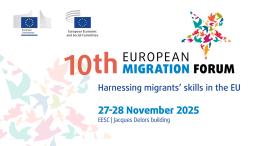
The European Migration Forum – the dialogue platform on migration, asylum and migrant integration - will meet for the tenth time on 27-28 November 2025.
Participation in the Forum meeting is by invitation only - the call for interested organisations is civil society organisations is now closed.
The strategic role of civil society in defending EU founding values
Location
EESC, Rue Van Maerlant 2, 1000
Brussels and online
Belgium
The sixth EESC FRRL Group's annual conference will provide a platform for debate of the annual EC rule of law report, as well as of the recent country visits carried out by the FRRL Group.
EESC Members, civil society representatives (including social partners), EU institutions and other stakeholders will discuss the main recent developments in the EU in the area of fundamental rights and the rule of law, as well as the EU response notably through the rule of law review mechanism.
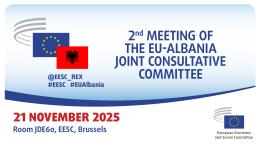
The second meeting of the EU-Albania Joint Consultative Committee (JCC) will took place on 21 November 2025 at the EESC in Brussels, Belgium. This platform, established within the institutional framework of the EU-Albania Stabilisation and Association Agreement (SAA), will enable representatives from both the EU and Albanian civil society to monitor the country's accession negotiations, discuss issues of common interest, and highlight concerns to be addressed on Albanian's path towards the European Union.
The European Economic and Social Committee (EESC) will actively participate in the 30th Conference of the Parties to the United Nations Framework Convention on Climate Change (COP30), to be held in Belém, Brazil, from 10 to 21 November 2025.
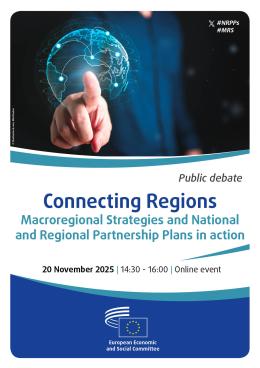
The EESC's objective with this debate is to underscore the importance of aligning macroregional strategies with national regional partnership plans (NRPPs) in order to boost cohesion and cross-border cooperation.
The EU Domestic Advisory Group (DAG) set up under the EU-New Zealand Free Trade Agreement (FTA) and tasked with advising on its implementation, held its first ever meeting at EESC premises, on 14 November 2025.
The NAT section is organising a debate on the European Environment Agency's recently published flagship report "Europe's Environment 2025" to deepen understanding, foster dialogue, and catalyse action towards building common ground for transformative solutions.
The event will bring together stakeholders from EU and national institutions, social partners, civil society organisations and academia, to exchange their views on crucial questions related to:
- how to unlock the potential of people that are underrepresented in the labour market (ESDE 2025 - discussed in session 1 – 14:30 – 15:45);
- how to promote quality jobs, including fair wages, and a competitive economy (LMWD 2025 – discussed in session 2 – 16:15 – 17:30).
The public hearing will examine how national, local and civil society actors will work together to foster collaboration through partnership principle and multi-level governance in order to deliver more inclusive, sustainable, and resilient outcomes across all regions.
The 16th meeting of the EU-Moldova Civil Society Platform took place on 11 November 2025. The debate focused on assessing the state of play in the implementation of the EU-Moldova Association Agreement, as well as the progress made by the Republic of Moldova in childcare reform and the protection of the rights of persons with disabilities.
The Platform also discussed Moldova’s Economic Growth Plan, aimed at fostering a more dynamic, sustainable, and competitive economy.