
European Economic
and Social Committee
EESC sets out shared vision with Irish Presidency
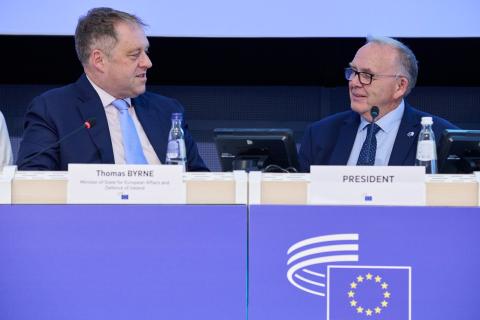
The debate with EESC members held at the July plenary session left no doubt that the programme of the current EU Presidency strongly resonates with the concerns and expectations of Europe’s organised civil society.
The European Economic and Social Committee (EESC) will work closely with the Irish Government during its Presidency of the Council of the European Union over the next six months. The July plenary debate with Thomas Byrne, Ireland’s Minister of State for European Affairs and Defence, revealed shared objectives with the EESC and a focus on harnessing the support of organised civil society to shape EU policy together.
Under the motto ‘Strength with unity’, the Irish Presidency’s work will be centred on the core pillars of competitiveness, values and security, which are interlocking and mutually reinforcing. Key objectives will be to foster the prosperity and wellbeing of EU citizens, uphold the indispensable foundation of the European Union and ensure that citizens are protected.
‘The Irish Presidency will continue in its work to find consensus between Member States on policies, which fall under each core Irish Presidency pillar, and these objectives will be underpinned by meaningful engagement with citizens and civil society,’ said Minister Byrne. ‘Europe is stronger when people are heard and represented, and that is why the Irish Presidency priorities have been informed by extensive consultation with the public. I look forward to continued engagement with the EESC, in the spirit of our Presidency slogan, “Ní neart go cur le chéile” – “Strength with unity”.’
For his part, Committee President Séamus Boland stressed that the Minister’s presence was ‘politically significant’ and added: ‘We greatly appreciate that, at the very beginning of its Presidency, Ireland has chosen to engage with the EESC at ministerial level. This sends a strong message about the importance your Presidency attaches to organised civil society and to the role of participatory democracy in shaping European policies. Your Presidency’s motto perfectly captures the spirit of the European project and the mission of this Committee.’
The EESC-Irish Presidency partnership
Ireland’s strong commitment to dialogue with organised civil society has translated into a request for eight exploratory opinions by the EESC. Through this type of opinion, the Committee is able to issue recommendations before EU institutions propose new legislation, allowing civil society to provide early input on policy issues.
The exploratory opinions requested by the Irish Presidency cover the following joint priorities: equality and competitiveness, SMEs and simplification, digital fairness, inclusive democratic participation, affordable housing, intergenerational poverty, and agriculture and food.
The partnership will also include a high-level conference on affordable housing, which will take place in November in Dublin.
In addition, the Committee will contribute to the Presidency’s cultural programme through a number of events celebrating Irish language, heritage and artistic expression.
For more information about the cooperation with the Irish presidency, please visit our website.
The views of EU organised civil society
‘Ireland knows what it takes to turn a lingering economy into a competitive one. Competitiveness is the condition for quality jobs, for financing the green and digital transitions, and for sustaining our social model. Europe has the assets: industrial capacity, a world class workforce and a powerful Single Market. What we need now is to unlock them through simplification, a real completion of the Single Market and open trade.’
Sandra Parthie, President of the EESC’s Employers’ Group
‘Hear the voice of the people, hear the voice of civil society: tackle the social crisis breeding under our feet. Inaccessible housing, persisting poverty, rising cost of living, few quality jobs. Your motto is “Strength with unity”. True unity comes from solidarity, but we do not see any significant reference to social policy in your priorities. Push for a Europe that works for its people.’
Lucie Studničná, President of the EESC’s Workers’ Group
‘The European project will only succeed if civil society is effectively involved at every stage. Beyond that we must take all possible measures to protect our values and peace in the EU. Sustainable development must remain our compass, striking a balance between economic growth and a competitive social market economy.’
Cillian Lohan, President of the EESC’s Civil Society Organisations’ Group
List of exploratory opinions
INT/1131 - Making civil society a driving force in the understanding and implementation of the Single Market Strategy (to be adopted at September plenary)
SOC/874 - Equality and the Competitiveness Agenda (to be adopted at September plenary)
INT/1130 - SMEs & Simplification: How the simplification agenda can deliver for SMEs (to be adopted at September plenary)
INT/1132 - Digital Fairness Act (to be adopted at September plenary)
SOC/873 - Inclusive Democratic Participation: Promoting Civil Society in Communities (to be adopted at October plenary)
TEN/889 - Making Housing Affordable – Increasing Modern Methods of Construction and Lowering Costs (to be adopted at September plenary)
SOC/875 - Anti-poverty strategy and inter-generational poverty (to be adopted at September plenary)
NAT/993 - Sustainable Livestock Strategy 2026 (to be adopted at July plenary)
Downloads
-
EESC sets out shared vision with Irish Presidency